
Cash to Accrual Accounting
Cash to Accrual Accounting Services in Oman are no longer optional; they’re essential. Unlike the cash method, which records income and expenses only when cash changes hands, accrual accounting recognizes revenue when earned and expenses when incurred.
This provides a more accurate, complete, and timely view of a business’s financial performance. For companies seeking growth, investor confidence, and alignment with global standards like IFRS, transitioning to accrual accounting is an important step.
At MFN Auditing, we specialize in guiding businesses through this transformation with precision and care. We don’t just perform a technical conversion; we enable strategic, regulatory-compliant financial reporting that supports smarter decision-making.
Our services also align with the Oman Commercial Companies Law and Oman Tax Law, ensuring your business stays on the right side of both compliance and competitiveness.
Scope of Cash to Accrual Accounting
Transitioning from cash-based to accrual accounting is a vital step for growing businesses in Oman, as it provides a more accurate and complete picture of financial performance.
Accrual accounting captures revenues and expenses when they are incurred, not just when cash is exchanged, enabling better financial planning, improved compliance, and enhanced transparency.
This shift is especially important for organizations seeking to align with international standards such as IFRS, meet regulatory requirements, and prepare audit-ready financial statements.

Who Benefits Most From Cash to Accrual Accounting in Oman
Accrual accounting is particularly valuable for businesses that issue invoices, manage credit transactions, or operate in industries with complex revenue cycles. SMEs benefit by gaining clearer visibility into their financial obligations and earnings, which strengthens investor confidence and supports loan applications. Large corporations rely on accrual accounting to comply with IFRS and CMA rules, ensuring their statements are transparent and globally comparable.
Even startups find value in adopting accrual accounting early, as it sets a strong foundation for growth and prepares them for audits and regulatory filings. MFN Auditing supports businesses across all sectors, ensuring that financial reporting reflects true performance rather than just cash flow.
When Should Businesses Transition From Cash to Accrual Accounting in Oman?
The transition from cash to accrual accounting in Oman should be considered when a business begins to expand, attract investors, or face regulatory requirements. Companies preparing for audits, entering into long‑term contracts, or seeking international partnerships benefit greatly from accrual accounting.
It is also essential when businesses want to align with IFRS standards or meet Oman Tax Law obligations. MFN Auditing helps organizations identify the right timing for conversion, ensuring that the transition strengthens compliance, improves transparency, and supports strategic decision‑making.
Process For Cash to Accrual Accounting
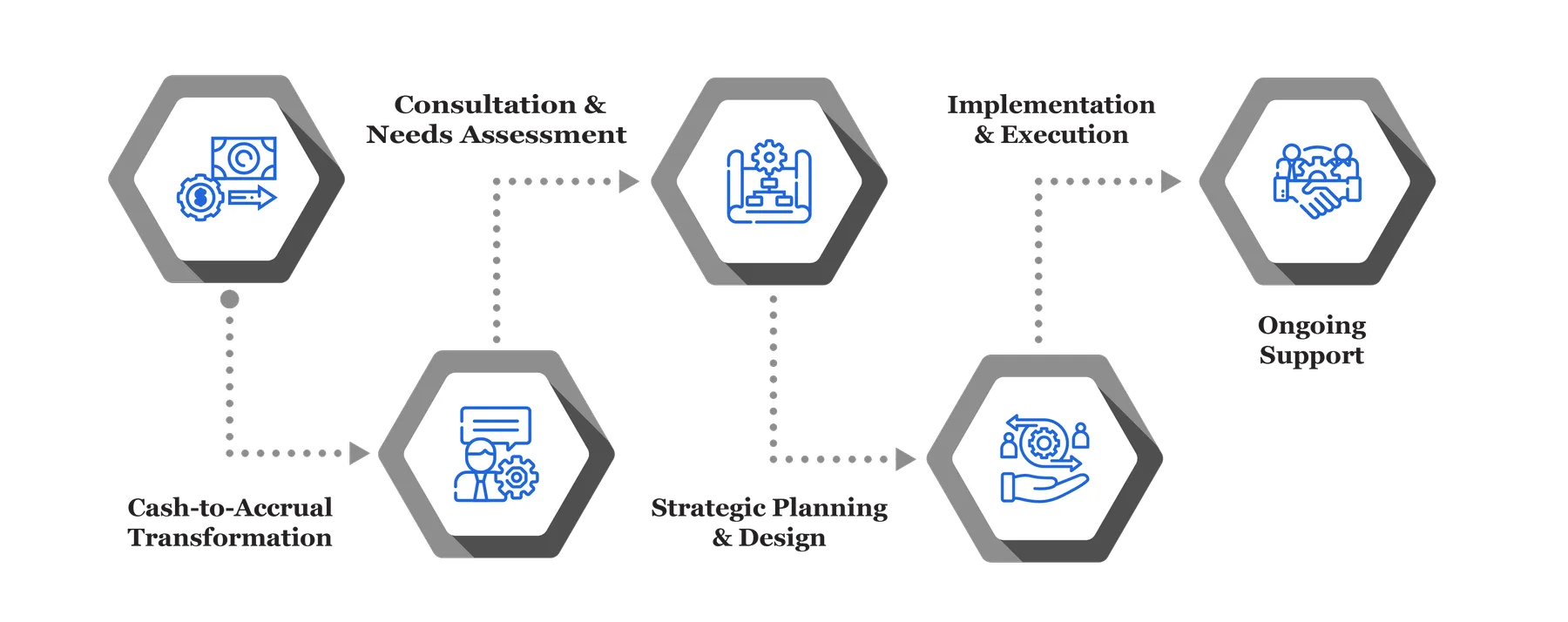
- Cash-to-Accrual Transformation Overview
Transitioning from a cash-based to an accrual accounting system is essential for accurate reporting, compliance, and strategic financial management in Oman. - Consultation & Needs Assessment
We evaluate your existing cash-based accounting setup, identify compliance risks and inefficiencies, and define the scope of your accounting transformation. - Strategic Planning & Design
Our team develops a tailored roadmap that includes required adjustments, reporting format changes, and a transition timeline aligned with Oman’s regulatory requirements - Implementation & Execution
We manage a seamless transition—adjusting historical records, journal entries, and preparing accrual-based financial statements, revenue reconciliations, and revised cash flow reports. - Ongoing Support & Optimisation
After conversion, we provide continued support through system reviews, compliance checks, staff training, and updates based on evolving IFRS and local laws.
Latest Blog
Book an Appointment with Us
Schedule a consultation with MFN Auditing Services today and discover how our expert Actuarial Valuation and financial consulting services can enhance the accuracy and reliability of your financial records.
Core Concepts: What Makes Accrual Accounting a Game-Changer?
While cash and accrual methods both track finances, their logic is entirely different. Cash accounting logs transactions when cash is exchanged. Accrual accounting, however, records revenue and expenses when they are earned or incurred, regardless of cash flow. This gives companies a more realistic and timely view of financial activities.
Examples:
- A sale made in July but paid in August? Accrual accounting records it in July.
- Received a utility bill in December but paid it in January? It’s logged in December.
By using the accrual accounting Oman method, businesses report earnings and obligations as they happen, not when money moves.
Understanding Accrued Expenses and Key Accounting Entries
Accrued expenses are costs a company incurs but hasn’t yet paid. Recognizing these entries ensures that income and costs are aligned in the same period, keeping reports accurate.
Key Accrual Entries:
- Revenue earned before cash is received
- Expenses incurred before payment
- Adjustments for deferred income and liabilities
These entries influence every major part of the balance sheet, assets, liabilities, and revenue. For companies complying with the CMA Rules or preparing for an audit, this accuracy is non-negotiable.
Benefits of Switching to the Accrual Basis of Accounting
- Real-Time Accuracy: Reports reflect your actual business activity.
- Better Planning: Plan ahead using predictive financial insights.
- Improved Compliance: Meet international and local reporting rules.
- Informed Decisions: Financial statements that truly tell your story.
For companies deciding between cash vs accrual accounting, the accrual method supports long-term growth and investor confidence.
What Risks Arise Without Accrual Accounting
Operating solely on a cash to accrual accounting in Oman basis exposes businesses to several risks:
- Incomplete reporting: Cash accounting fails to capture obligations and revenues in the correct period, leading to misleading financial statements.
- Regulatory penalties: Non‑compliance with IFRS or CMA rules can result in fines and reputational damage.
- Investor mistrust: Stakeholders may view cash‑based reports as lacking transparency, reducing funding opportunities.
- Poor planning: Without accrual data, businesses struggle to forecast expenses and revenues accurately.
- Audit challenges: cash to accrual accounting in Oman complicates audit readiness, as records do not reflect the full financial picture.
MFN Auditing ensures businesses avoid these risks by delivering accurate, accrual‑based reporting aligned with international and local standards.
Which Challenges Do Companies Face During Cash to Accrual Conversion
Transitioning to cash to accrual accounting in Oman can be complex, and businesses often encounter obstacles such as:
- Historical adjustments: Converting past cash‑based records into accrual entries requires precision and expertise.
- Technical complexity: Understanding deferred income, accrued expenses, and liabilities can overwhelm internal teams.
- System limitations: Legacy accounting software may not support accrual frameworks without upgrades.
- Compliance alignment: Companies must ensure accrual records meet IFRS, CMA, and Oman Tax Law requirements simultaneously.
- Resource constraints: SMEs may lack dedicated finance teams to manage the transition.
- Time pressure: Conversion often coincides with reporting deadlines, leaving little room for error.
MFN Auditing cash to accrual accounting in Oman addresses these challenges by applying structured processes, advanced tools, and certified expertise to deliver seamless conversions.
How Much Do Cash to Accrual Accounting Services Cost in Oman
The cost of conversion depends on company size, transaction volume, and reporting requirements. Smaller firms may only need basic adjustments, while larger corporations require comprehensive services including historical record conversion, IFRS alignment, and audit preparation. Costs also vary depending on whether training, compliance reviews, or system upgrades are included. MFN Auditing cash to accrual accounting in Oman provides transparent pricing, offering scalable solutions for SMEs and detailed packages for corporates.
Note: Costs vary by scope. Contact MFN Auditing for a personalized quote.
In What Ways Does MFN Use Technology to Support Cash to Accrual Accounting
MFN Auditing cash to accrual accounting in Oman integrates modern technology to streamline cash‑to‑accrual conversions:
- Automated reconciliation tools: Adjust historical records and journal entries with accuracy.
- Cloud‑based accounting platforms: Provide secure, real‑time access to accrual‑based financial data.
- Compliance software: Verify alignment with IFRS, CMA rules, and Oman Tax Law.
- Data visualization dashboards: Present accrual‑based performance clearly for management and stakeholders.
- Secure digital systems: Protect sensitive financial records while ensuring accessibility for audits.
By combining technology with professional expertise, MFN Auditing delivers conversions that are efficient, transparent, and fully compliant.
Core Tools & Technologies in Cash to Accrual Accounting
| Category | Typical Duration | Primary Use Case |
|---|---|---|
| ERP/Accounting Systems | SAP, Oracle, Dynamics 365 | Transition to accrual-based accounting |
| Cloud Bookkeeping | QuickBooks, Xero, Zoho | SME bookkeeping & accrual adjustments |
| Reporting & Compliance | Tagetik, Workiva, ONESOURCE | IFRS-compliant reporting & tax compliance |
| Analytics & Visualization | Excel, Power BI, Tableau | Reconciliations & accrual dashboards |
| Automation & AI | UiPath, Automation Anywhere | Automating accrual entries & reconciliations |
| Document Management | SharePoint, DocuSign | Secure workflow & accrual documentation |
Industries Supported by MFN’s Cash to Accrual Expertise
MFN Auditing provides cash‑to‑accrual services across diverse industries in Oman, including:
- Retail and distribution: Accurate cash to accrual accounting in Oman reporting of credit sales and inventory costs.
- Manufacturing: Alignment of production expenses and revenues with IFRS standards.
- Financial services: Compliance with CMA and Central Bank guidelines.
- SMEs and startups: Affordable conversions that strengthen investor confidence and audit readiness.
Why Choose MFN Auditing?
- Choosing MFN Auditing means gaining a trusted partner with deep knowledge of cash to accrual accounting services in Oman and local regulations.
- We go beyond basic bookkeeping, implementing financial systems that reflect true business performance and ensure compliance.
- Our team includes certified public accountants and financial experts skilled in financial transformation and accurate reporting.
- We specialize in delivering tailored Cash to Accrual Accounting Services in Oman for businesses of all sizes and sectors.
- From assessment to full conversion, we provide hands-on support, consulting, and audit readiness at every stage.
- With MFN, your business stays transparent, resilient, and fully equipped for long-term financial growth.
Contact Us
FAQS
For businesses dealing in credit or preparing for audits, accrual accounting provides a more accurate picture.
Yes, MFN manages mid‑year conversions with adjustments to ensure compliance.
Accrual accounting aligns with Oman Tax Law, ensuring obligations are reported correctly
Accrued expenses are incurred but unpaid, while prepaid expenses are paid in advance.
MFN provides guidance on upgrading or adapting systems to support accrual frameworks.