
ESR Advisory Services in Oman
Economic Substance Regulations (ESR) were introduced in Oman as part of a GCC‑wide initiative to align with international tax transparency and anti‑avoidance measures. Rooted in OECD and EU frameworks, these rules aim to curb harmful tax practices and profit shifting.
They require entities to undertake genuine economic activities in the jurisdictions where they are registered, proving that income is aligned with real business presence. In Oman, ESR compliance is now both a legal mandate and a strategic necessity.
As enforcement efforts intensify, businesses must understand and fulfill their obligations to avoid financial penalties and reputational damage. More than just a requirement, ESR reflects transparency, local value creation, and operational integrity—qualities that appeal to global investors and build long‑term stakeholder trust.
What Is ESR Advisory and Why Does It Matter?
ESR advisory is more than a compliance exercise it is a strategic framework that ensures businesses demonstrate genuine substance in Oman. In a regulatory environment shaped by global tax standards, ESR compliance protects companies from penalties, strengthens investor confidence, and ensures operational credibility.
Without ESR compliance, businesses risk fines, license suspension, and reputational harm. With structured ESR advisory, organizations gain resilience, transparency, and long‑term sustainability.

Scope of ESR Advisory Services
ESR Advisory Services are essential for businesses to meet Oman’s Economic Substance Regulations confidently. They help identify relevant activities, address compliance gaps, and support proper documentation and filings.
This reduces the chance of penalties and strengthens a company’s standing with local authorities. It also supports responsible operations and builds trust with partners and stakeholders.
Applicable across various sectors, these services suit all business types and sizes. Strong ESR compliance ensures legal alignment and contributes to long‑term stability in Oman.
ESR Filing & Notification Process in Oman
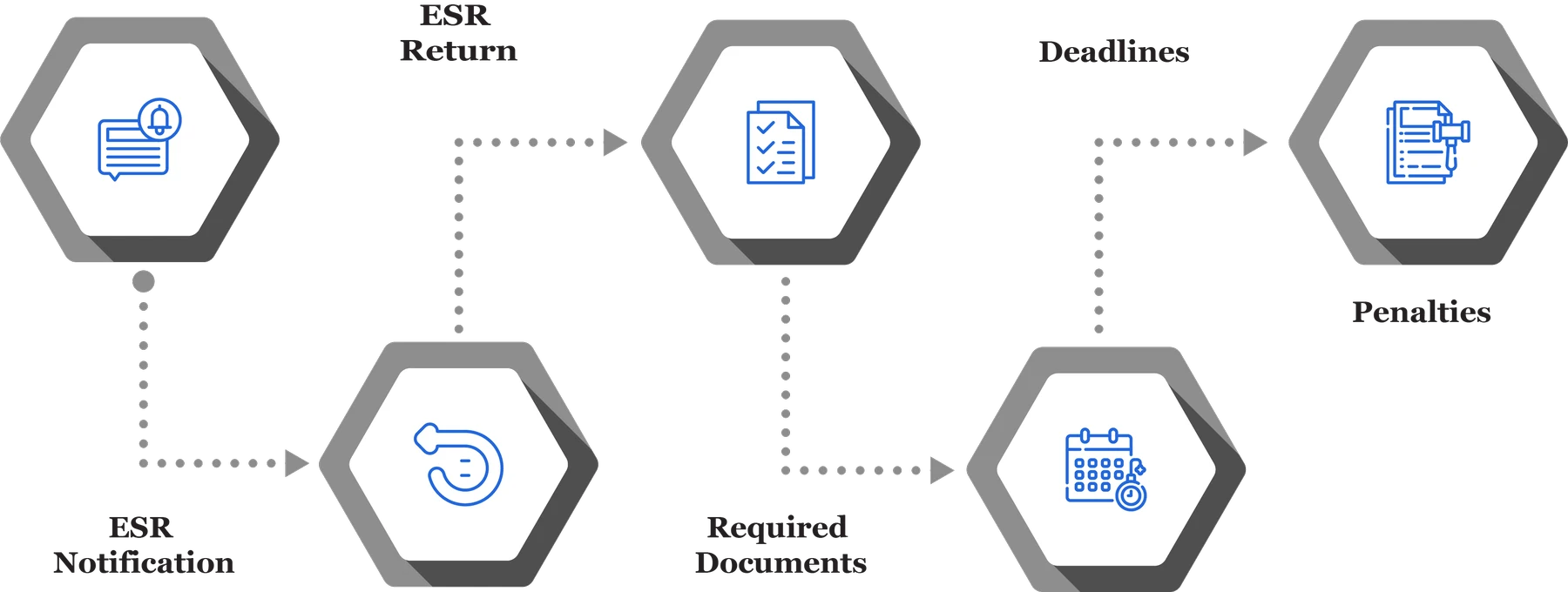
ESR Notification – Filed annually within six months of the financial year‑end to notify authorities of relevant activities.
ESR Return – Submitted within 12 months after the financial period ends, supported by evidence proving compliance.
Required Documents – Commercial registration, audited financials, business activity proof, employee contracts, and lease agreements.
Deadlines – Six‑month notification and 12‑month return deadlines must be met to avoid penalties.
Penalties – Non‑compliance can result in fines, increased scrutiny, and reputational damage.
Book an Appointment with Us
Schedule a consultation with MFN Auditing Services today and discover how our expert Actuarial Valuation and financial consulting services can enhance the accuracy and reliability of your financial records.
Who Needs to Comply with ESR in Oman?
The ESR law applies to any entity undertaking one or more of the following activities:
- Holding company business
- Headquarters business
- Shipping business
- Leasing and finance business
- Intellectual property (IP) business
- Distribution and service center business
- Banking
- Insurance
- Investment fund management
Compliance is activity‑based, not industry‑based. If your entity engages in any relevant activity, you must file an ESR notification and, if applicable, submit an ESR return.
MFN Auditing’s ESR Advisory Services
ESR Impact Assessment – Determine applicability of ESR to your entity.
Gap Analysis & Documentation – Identify compliance gaps and prepare documentation.
Filing Support – End‑to‑end support with ESR Notification and ESR Return.
Policy & Substance Advisory – Guidance on physical presence, qualified employees, and operational substance.
Ongoing ESR Monitoring – Continuous updates on ESR rules and compliance requirements.
How Much Do ESR Advisory Services Cost in Oman?
Costs vary depending on company size, industry, and complexity of ESR obligations. SMEs may require basic filing support, while larger corporations often need comprehensive advisory and monitoring.
MFN Auditing provides transparent pricing tailored to your needs.
Note: Costs are estimates. Contact MFN Auditing for a customized quote.
Documents Needed for ESR Advisory in Oman
To ensure smooth ESR compliance, businesses should prepare:
- Commercial Registration (CR) certificate
- Audited financial statements
- Employee contracts and payroll records
- Lease agreements and proof of premises
- Shareholder and governance documents
MFN Auditing provides detailed checklists to ensure readiness and avoid delays.
Eligibility to Apply for ESR Advisory Services
ESR advisory services are required for:
- SMEs engaging in ESR‑relevant activities
- Corporations with cross‑border operations
- Family businesses with holding structures
- Free Zone entities subject to ESR rules
- Foreign investors establishing subsidiaries in Oman
Project Timelines for ESR Advisory Services in Oman
Phase | Typical Duration
- Consultation & Assessment – 1–2 weeks
- Strategic Planning – 2–3 weeks
- Filing & Submission – 1–2 weeks
- Post‑Filing Support – Continuous
Note: Timelines are estimates. Actual duration depends on company size, industry, and readiness of documentation.
Penalties for ESR Non‑Compliance in Oman
Failure to comply with ESR obligations can result in:
- Financial Penalties – OMR 1,000 to OMR 20,000 depending on severity.
- License Suspension or Cancellation – For repeated or willful violations.
- Reputational Damage – Inaccurate filings increase scrutiny under commercial law.
MFN Auditing helps businesses avoid these risks with proactive ESR advisory.
Relevant Laws, Standards, or Industry Frameworks
- Economic Substance Law Oman – Establishes ESR requirements.
- Ministerial Decision No. 100/2020 – Provides ESR classification and compliance guidance.
- OECD BEPS Framework – Global foundation for ESR regulations.
- Oman Commercial Companies Law – Defines governance structures for ESR compliance.
- Oman Tax Procedures Law – Outlines filing obligations and audit procedures.
Key Benefits of ESR Advisory Services in Oman
Cost Savings – Prevents penalties and reduces inefficiencies.
Risk Reduction – Ensures compliance with Omani laws and OECD standards.
Operational Efficiency – Strengthens systems and improves documentation.
Investor Confidence – Builds credibility with stakeholders.
Strategic Alignment – Positions businesses to meet Vision 2040 goals.
Challenges Without ESR Advisory
Companies without ESR advisory face penalties, reputational damage, and operational instability. In Oman, frequent updates in ESR laws make unmanaged compliance unsustainable. MFN Auditing helps overcome these challenges with proactive, regulator‑aligned strategies.
Core Tools & Technologies in ESR Advisory
| Category | Common Tools/Technologies | Primary Use Case |
|---|---|---|
| Compliance Tools | CaseWare, AuditBoard | ESR filings & governance alignment |
| Document Management | SharePoint, DocuSign | Secure handling of ESR records |
| ERP/Accounting Systems | SAP, Oracle, Dynamics 365 | Financial reporting & ESR compliance |
| Data Analytics | Power BI, Tableau | Monitoring ESR activities & reporting |
| Communication Platforms | MS Teams, Zoom | Stakeholder coordination & training |
Why Choose MFN Auditing for ESR Advisory in Oman?
MFN Auditing has a team of experienced ESR consultants with in‑depth knowledge of Oman’s Economic Substance Law and its local application. Each advisory service is tailored to your business model, ensuring practical and fully compliant ESR solutions. We use structured tools and up‑to‑date frameworks to deliver accurate assessments and timely ESR filings. Our services are trusted by local firms, Free Zone entities, and multinationals for reliable ESR compliance support. With strong regulatory insight and hands‑on experience, we help clients manage ESR obligations with confidence. A proven track record of clarity, accuracy, and responsiveness makes us a preferred partner for ESR advisory in Oman.
Contact Us
FAQS
You may face financial penalties and increased audit risk under Oman’s ESR framework.
MFN Auditing conducts ESR impact assessments to determine applicability based on your business activities.
Yes. We support both local and foreign‑owned entities in meeting ESR obligations.
CR certificate, audited financials, employee contracts, lease agreements, and shareholder records.
Yes. Free Zone entities are subject to ESR rules if they engage in relevant activities.