
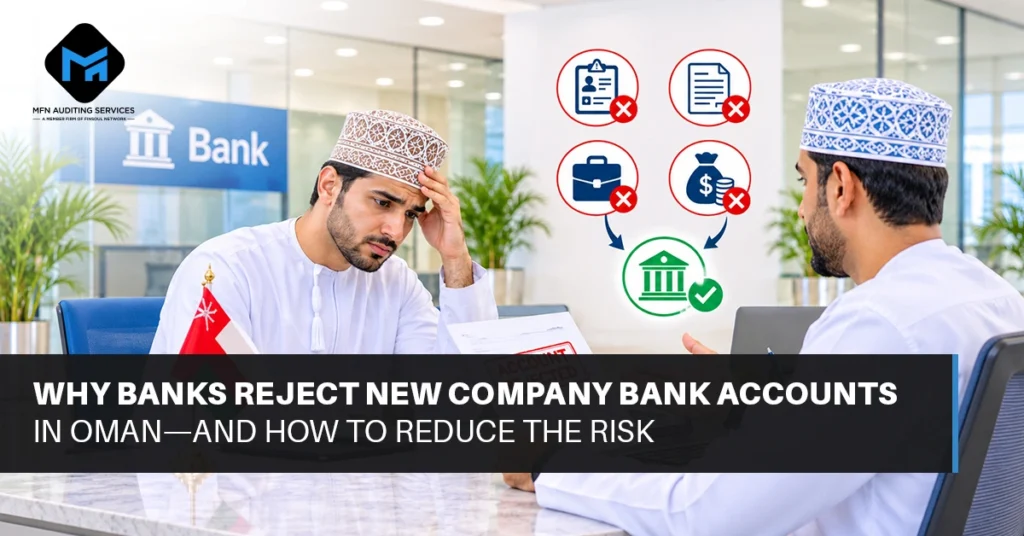
Registering a company in Oman is an important step towards starting business operations, but it does not automatically secure a corporate bank account. Banks conduct independent verification before accepting a new business customer. They examine the company’s legal documents, shareholders, ultimate beneficial owners, business activities, source of funds and expected transactions.
An application that lacks clear ownership information, contains inconsistent documents or presents an unclear business model creates immediate compliance concerns. The bank can request further evidence, suspend the application or decline to establish the banking relationship.
Understanding the corporate bank account requirements in Oman before approaching a bank helps businesses prepare complete documentation and present a credible financial profile. This guide explains the main reasons banks reject new company accounts and the practical steps companies can take to reduce the risk.
Why Banks Reject New Company Bank Account Applications in Oman
Banks in Oman follow customer due diligence and anti-money laundering requirements supervised by the Central Bank of Oman (CBO). These requirements oblige financial institutions to verify customers, identify beneficial owners, understand ownership and control structures, and establish the purpose of a business relationship.
Article 33 of Oman’s Anti-Money Laundering and Combating the Financing of Terrorism Law addresses customer identification, verification of people acting on behalf of customers and beneficial ownership checks. Banks also assess the nature of the expected relationship and apply additional checks when the risk profile calls for them.
1. Incomplete or Inconsistent Company Documentation
Banks need accurate corporate records to establish the company’s legal identity, ownership, management and authority to operate an account. Missing documents or conflicting information make verification difficult.
For example, the CR might show one authorised signatory while the account-opening request carries another person’s signature. Without a valid shareholder or board resolution confirming that person’s authority, the bank cannot establish that the application has received proper approval.
Other documentation problems include:
- An outdated commercial registration certificate.
- Differences in company names across registration documents and application forms.
- Shareholder details that do not match passport or identification records.
- Missing constitutive contracts or Articles of Association.
- Incomplete shareholder or board resolutions.
- An unverified company address.
- Missing licences for regulated business activities.
Bank Muscat’s published resident-company checklist requests a recent CR, Oman Chamber of Commerce and Industry membership certificate, identification documents for shareholders and authorised representatives, company constitutive documents, relevant resolutions and proof of physical address. Its checklist also specifies additional documentation for non-resident companies.
How to reduce the risk
Review every document before submission. Confirm that company names, registration details, shareholder information and authorised signatories match across the CR, constitutive contract, resolutions and bank application.
Prepare the latest corporate records and obtain the required signatures before contacting the bank. For overseas corporate documents, confirm the bank’s apostille, attestation and translation requirements in advance.
2. Unclear Ownership and Ultimate Beneficial Ownership
Banks need to identify the individuals who ultimately own or control a company. This verification becomes particularly important when a business has foreign shareholders, corporate shareholders, holding companies or several layers of ownership.
The ultimate beneficial owner (UBO) is the natural person who ultimately owns or exercises control over the legal entity. A bank needs sufficient information to understand how ownership passes through the company’s structure and who exercises effective control.
Consider an Omani LLC owned by an overseas holding company. The Omani company’s CR identifies its immediate shareholder, but it does not necessarily explain the individuals behind that holding company. The bank needs supporting corporate records to establish the full ownership chain.
Ownership-related problems include:
- Missing information about corporate shareholders.
- An incomplete ownership chart.
- Unclear ownership percentages.
- Differences between shareholder registers and submitted declarations.
- Missing identification documents for beneficial owners.
- Overseas corporate records without the required authentication.
- Unexplained relationships between shareholders, directors and signatories.
How to reduce the risk
Prepare an ownership chart that identifies every shareholder, ownership percentage and intermediate company. Trace corporate ownership through to the relevant natural persons and include supporting records.
For corporate shareholders, prepare incorporation certificates, constitutional documents, shareholder registers and board or shareholder resolutions. Collect passport or identification copies for the relevant individuals.
Keep the ownership information consistent with the company’s official records and UBO declarations. A transparent ownership structure gives the bank a clear basis for completing its verification.
3. Business Activities Do Not Match the Account Application
A bank needs to understand what the company does, how it earns revenue and why it needs a corporate account. Vague business descriptions or activities that conflict with the company’s registered operations create compliance concerns.
For example, a company registered for management consultancy that expects regular payments for imported consumer goods has an activity mismatch to explain. The bank needs to establish the commercial reason for those transactions and confirm that the proposed operations align with the company’s authorised activities.
Similar problems arise when a company lists several activities on its CR but cannot identify its main source of revenue, target customers or supplier relationships.
A business profile that only states “general trading” or “business services” does not provide enough detail for meaningful assessment.
How to reduce the risk
Prepare a concise business profile covering:
- Main products or services.
- Registered and licensed business activities.
- Target customers and supplier categories.
- Operating locations and target markets.
- Revenue sources and pricing model.
- Expected local and international transactions.
- Business purpose for opening the account.
For a trading company, explain the products it buys and sells, the countries involved and the payment arrangements with suppliers and customers. For a consultancy, describe its services, client categories and expected billing arrangements.
The explanation must match the company’s registration, licences and business plan.
4. Insufficient Evidence of Initial Capital and Source of Funds
Banks examine the origin of money entering a corporate account. They need to understand who provides the funds, how the money was obtained and why it is being transferred to the company.
New companies frequently lack audited financial statements and an established trading history. However, shareholders still need to explain the company’s initial funding and provide supporting evidence.
For example, if shareholders plan to transfer OMR 50,000 as initial business funding, the bank needs a credible explanation of the contribution and evidence supporting its origin.
Useful documents include:
- Personal or corporate bank statements.
- Shareholder capital contribution records.
- Investment agreements.
- Shareholder or board resolutions approving the funding.
- Loan agreements and lender details.
- Supporting records for funds generated through asset sales or other sources.
How to reduce the risk
Document every significant funding arrangement before transferring money. If an overseas shareholder funds the company, prepare the investment agreement, relevant corporate approval and supporting financial evidence.
Avoid unexplained cash deposits, informal transfers and payments from unrelated third parties. Every substantial contribution should have a documented commercial or investment purpose.
5. Company Address Cannot Be Verified
Banks need evidence that supports the company’s registered or operating address. An address that cannot be verified creates uncertainty about the business’s physical presence and operations.
Problems include expired tenancy agreements, incomplete rental records, differences between the CR and address documents, or the use of a shared business address without acceptable supporting evidence.
Bank Muscat’s published checklist identifies several forms of physical-address evidence, including a rental agreement, municipality authority certificate, utility bill or property deed.
How to reduce the risk
Arrange valid address documentation before submitting the application. Check that the company name and address match the relevant corporate records.
Businesses operating from serviced offices or shared premises need to confirm which supporting documents the selected bank accepts. Do not assume that every bank treats virtual offices, business centres and conventional commercial premises in the same way.
6. Shareholders and Authorised Signatories Fail Verification
Banks verify the identity and authority of the people involved in opening and operating the account. This includes shareholders, directors, beneficial owners and authorised signatories, depending on the company’s structure and the bank’s requirements.
An application can stall when identification documents are missing, passport details are inconsistent or the person submitting the request cannot demonstrate authority to act for the company.
Foreign shareholders and non-resident directors also need to prepare documents in the format accepted by the bank. Overseas corporate records frequently involve additional authentication requirements.
Banks also conduct politically exposed person (PEP) and sanctions screening. A PEP connection does not automatically result in rejection, but it can trigger enhanced due diligence and additional verification.
How to reduce the risk
Identify every person who needs to participate in the verification process. Prepare valid passport, civil ID or resident card copies as applicable. Include the resolutions and authorisations that establish who can open and operate the account.
Confirm attendance requirements and document presentation procedures with the corporate banking team before arranging appointments.
7. Expected Transactions Create Compliance Concerns
Banks assess the expected financial activity of a company before opening an account. They need to understand transaction values, payment frequency, countries involved and the commercial purpose of incoming and outgoing funds.
An application becomes difficult to assess when a new company reports high projected turnover without explaining its customers, suppliers or business capacity.
For example, a small consultancy expecting frequent high-value transfers from several unrelated countries needs to provide a clear commercial explanation. The bank will compare the proposed account activity with the company’s registered operations and business profile.
Prepare realistic estimates covering:
- Expected monthly and annual turnover.
- Average incoming and outgoing payment values.
- Number of monthly transactions.
- Main customer and supplier locations.
- Expected international transfers.
- Required currencies.
- Cash deposit activity, where relevant.
- Purpose of major or recurring payments.
Corporate Bank Account Requirements Oman: Essential Document Checklist
The exact requirements differ between banks, legal structures, ownership arrangements and account products. The following checklist covers documents commonly requested during corporate onboarding.
| Document | Purpose |
| Commercial Registration certificate | Confirms the company’s legal registration and registered activities. |
| Constitutive contract, MOA or AOA | Establishes the company’s structure, shareholders and governance arrangements. |
| Oman Chamber of Commerce and Industry certificate | Supports the company’s commercial documentation where applicable. |
| Passport, civil ID or resident card copies | Verifies shareholders, directors and authorised signatories. |
| Shareholder or board resolution | Authorises account opening and identifies representatives with signing powers. |
| UBO declaration and ownership chart | Identifies the individuals who ultimately own or control the company. |
| Tenancy agreement or address evidence | Supports verification of the company’s physical address. |
| Company account-opening request letter | Records the formal request and authorised signatures. |
| Business profile or business plan | Explains activities, customers, suppliers and expected transactions. |
| Source-of-funds evidence | Explains initial capital and other expected funding. |
| Relevant commercial or sector licences | Confirms authorisation for regulated activities. |
Banks also use compliance declarations and forms relevant to the customer’s circumstances. These include FATCA, Common Reporting Standard (CRS), PEP and sanctions-related documentation.
Companies with overseas corporate shareholders need to prepare additional incorporation and ownership records. Bank Muscat’s published checklist specifically addresses documentation for non-resident companies and corporate shareholders.
How to Reduce the Risk of Corporate Bank Account Rejection
A strong application starts with preparation. Business owners need to organise legal records, explain the company’s operations and support the financial information presented to the bank.
1. Verify the Company’s Legal Records
Check the CR, constitutive contract, shareholder details and registered activities. Resolve outdated information and discrepancies before submitting the application.
If the company operates in a regulated sector, prepare the relevant licence or approval. The bank needs to see that the proposed activities have the required legal authorisation.
2. Prepare a Complete Ownership File
Document every level of ownership and identify the relevant beneficial owners. Collect corporate records for holding companies and overseas shareholders, together with the required identification documents.
Check ownership percentages and names against official records. An incomplete ownership chart creates unnecessary verification work.
3. Build a Clear Business Profile
Explain how the company operates and generates revenue. Identify its customers, suppliers, products, services and operating markets.
Include realistic transaction estimates and explain international payment arrangements. The bank needs a consistent picture of the business before assessing its proposed account activity.
4. Document Initial Funding
Prepare evidence of shareholder contributions, investment funding and business loans. Match the supporting records with the amounts and funding arrangements described in the application.
Where money comes from overseas, document the sender, relationship with the company and purpose of the transfer.
5. Confirm the Bank’s Current Requirements
Contact the corporate banking department before submitting documents. Ask for the latest checklist and confirm requirements for foreign shareholders, non-resident directors, original documents, address verification and account authorisations.
Also check minimum balance conditions, account fees, online banking facilities, foreign currency options and international transfer services.
6. Select an Account That Matches the Business
Choose a corporate account based on the company’s actual banking needs. A local service provider, international trading company and manufacturing business do not have identical transaction requirements.
Explain the expected use of the account and confirm that the selected banking product supports the company’s payment volumes, currencies and operating markets.
What to Do When a Bank Rejects Your Application
A bank rejection does not automatically mean that the company is unlawfully registered or permanently ineligible for banking services. It means the bank has decided not to establish the relationship based on its assessment.
The company needs to address the underlying issue before submitting another application.
Follow these steps:
- Request clarification: Ask the bank to identify any missing documents or information gaps it can disclose.
- Review the submitted file: Compare the application with the bank’s checklist and check every corporate and financial record.
- Correct inconsistencies: Update outdated registration details, resolutions, ownership information or address records.
- Strengthen the business explanation: Provide clearer information about activities, customers, suppliers and expected transactions.
- Prepare additional funding evidence: Support shareholder contributions and significant incoming transfers with appropriate records.
- Approach another suitable bank: Select a bank whose corporate banking services match the company’s ownership structure and operating needs.
Banks are not required to disclose confidential internal risk assessments. However, the company can still correct identifiable documentation gaps and improve the quality of its supporting information.
How MFN Auditing Supports Businesses with Financial and Corporate Documentation in Oman
Corporate banking preparation depends on accurate company records and a clear financial profile. Businesses need organised accounting information, consistent corporate documentation and reliable explanations of their funding and expected transactions.
MFN Auditing provides accounting, audit, tax, financial advisory and corporate services to businesses operating in Oman. Its support helps companies maintain financial records, organise business information and address important administrative and compliance requirements.
MFN Auditing supports businesses through:
- Accounting and bookkeeping: Recording sales, purchases, bank transactions, payroll and other financial activities.
- Financial statement preparation: Preparing financial statements and management accounts that present the company’s financial position and performance.
- Financial advisory: Supporting financial planning, business decisions and the organisation of financial information.
- Company formation: Assisting businesses with company establishment and related corporate requirements.
- Regulatory matters: Helping businesses address relevant regulatory and administrative obligations.
Companies can explore MFN Auditing’s accounting and bookkeeping services in Oman for support with financial records and reporting.
Frequently Asked Questions
1. What are the corporate bank account requirements in Oman?
Banks commonly request a valid Commercial Registration, company constitutive documents, shareholder and authorised signatory identification, relevant resolutions, proof of business address and Oman Chamber of Commerce and Industry documentation where applicable.
2. Can a newly registered company open a corporate bank account in Oman?
Yes. A newly registered company can apply for a corporate account after completing the relevant registration requirements. The bank conducts independent due diligence and assesses the company’s ownership, business activities, funding and expected account activity before approving the application.
3. Can a foreign-owned company open a corporate bank account in Oman?
Foreign-owned companies can apply for corporate accounts in Oman. Banks verify foreign shareholders, beneficial owners and authorised representatives. They also request supporting corporate documents and apply the relevant authentication requirements to overseas records.
4. Why do banks ask for source-of-funds documents?
Banks need to establish where money entering an account originates and whether the funding is consistent with the company’s business profile. They use bank statements, investment agreements, capital contribution records and other supporting evidence to verify the source of funds.
5. Does a commercial registration guarantee bank account approval?
No. A commercial registration confirms the company’s legal existence and registered activities. Bank approval is a separate decision based on customer due diligence, ownership verification, business activity and financial risk assessment.
6. Can a company apply to another bank after rejection?
Yes. A company can approach another bank after rejection. It should first review the application, correct documentation gaps and prepare a consistent explanation of its ownership, business activities and funding arrangements.
7. How long does a company bank account opening in Oman take?
Processing time depends on the bank’s procedures, document completeness, ownership structure and verification requirements. Applications involving foreign corporate shareholders, complex ownership arrangements or enhanced due diligence take additional preparation and review time. Banks provide their own processing guidance during onboarding.