
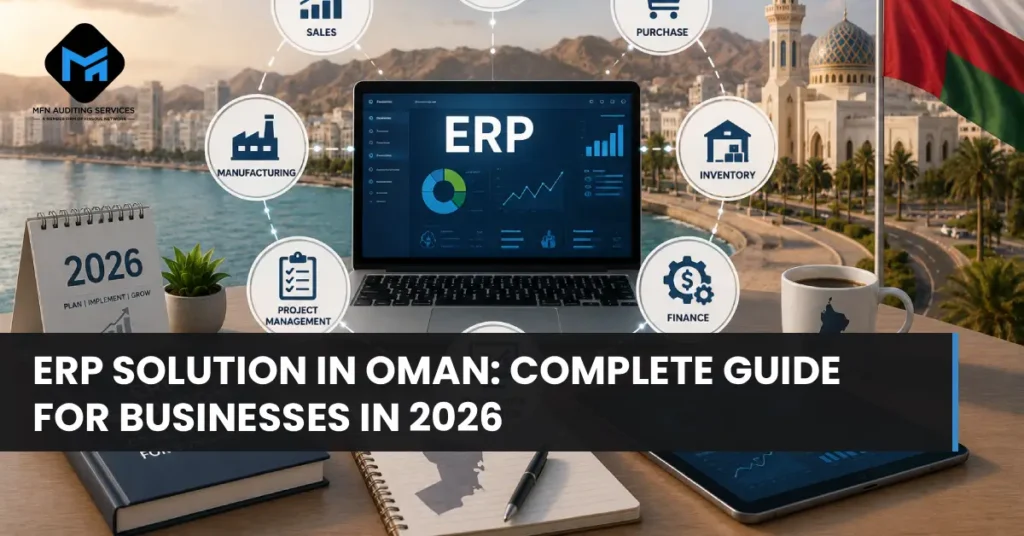
Businesses across Oman are rethinking how they manage operations. Manual processes, disconnected software, and fragmented data are limiting growth at a time when the market demands speed, accuracy, and agility. Digital transformation is no longer a long-term ambition for most companies; it is a practical necessity driven by competition, regulation, and rising customer expectations.
Enterprise Resource Planning (ERP) solutions sit at the centre of this shift. Organisations across manufacturing, construction, retail, logistics, and professional services are replacing legacy systems with integrated ERP platforms to gain control over their operations and make faster, better-informed decisions.
MFN Auditing covers everything businesses in Oman need to know about ERP solutions in 2026, from how they work and what they include to how to choose the right system and implement it effectively.
What Is an ERP Solution?
Enterprise Resource Planning is a category of business management software that integrates core operational functions into a single, connected platform. Finance, inventory, procurement, sales, human resources, and production all share a unified database, giving every department access to the same real-time information.
ERP is often confused with CRM or accounting software. A CRM manages customer relationships and sales activity. Accounting software handles financial transactions. ERP does both and connects them with every other function in the business, from warehouse management to payroll to project costing. The result is a single source of truth across the entire organisation.
For modern businesses, operating without an ERP system typically means managing multiple disconnected tools, re-entering data across platforms, and making decisions based on information that is already out of date.
Why Businesses in Oman Are Investing in ERP Solutions
Several forces are accelerating ERP adoption across Oman.
- Oman Vision 2040 places digital transformation at the centre of the country’s economic development strategy. Businesses investing in technology infrastructure are better positioned to participate in the diversified economy Vision 2040 is building, particularly in manufacturing, logistics, tourism, and knowledge-based industries.
- Growing competition across sectors is compressing margins and raising the bar for operational performance. Businesses that rely on manual processes and disconnected systems are slower to respond, more prone to errors, and harder to scale.
- Regulatory compliance and reporting requirements have become more structured. Managing VAT obligations, financial reporting, and industry-specific compliance manually carries increasing risk. ERP systems automate compliance tracking and generate the documentation regulators require.
- Real-time business insights have become a competitive advantage. Businesses with integrated ERP platforms can monitor performance, identify problems, and act on opportunities faster than those working from weekly spreadsheets and monthly reports.
How an ERP System Works
Centralised Database
All business data, from invoices and stock levels to employee records and customer orders, is stored in a single database. Every department accesses and updates the same information, eliminating duplication and ensuring consistency across the organisation.
Automation of Business Processes
Routine tasks such as purchase order generation, invoice processing, payroll calculations, and stock reordering are automated based on predefined rules. This reduces manual effort, accelerates workflows, and removes a significant source of human error.
Real-Time Reporting and Analytics
Because all data flows into a single system, reports reflect the current state of the business rather than a snapshot from the last manual export. Managers can access live dashboards covering financial performance, inventory levels, sales activity, and operational KPIs at any time.
Integration Across Departments
Actions in one department trigger automatic updates in others. A confirmed sales order updates inventory, triggers procurement if stock is low, and feeds into the finance module for invoicing. Information flows across the business without manual handoffs.
Workflow Management
ERP systems allow businesses to define approval workflows, escalation paths, and process controls. Purchase orders above a threshold require authorisation. Expenses follow a defined approval chain. Processes are governed by the system, not by informal practice.
Key Features of a Modern ERP Solution
Financial Management
A robust ERP finance module covers the general ledger, accounts payable, accounts receivable, budgeting, and financial reporting. Businesses can manage multi-currency transactions, generate VAT-compliant reports, and maintain audit-ready financial records without manual consolidation.
Inventory and Warehouse Management
Real-time stock tracking, barcode integration, and automated inventory forecasting give businesses accurate visibility over their supply chain. Overstocking and stockouts both carry cost; ERP helps find the balance.
Procurement and Purchasing
Supplier management, purchase order generation, and vendor performance tracking are centralised within the ERP. Procurement teams can compare supplier pricing, track delivery performance, and manage the full purchase-to-pay cycle in one place.
Sales and CRM
Customer records, sales pipelines, quotations, and invoicing are managed within the same platform. Sales teams have full visibility over account history, outstanding orders, and customer communication without switching between tools.
Human Resource Management (HRMS)
Payroll processing, attendance tracking, leave management, and employee records are handled within the ERP. For businesses in Oman managing Omanisation ratios and WPS payroll compliance, an integrated HRMS significantly simplifies administration.
Manufacturing Management
Production planning, Bill of Materials (BOM) management, and quality control are essential for manufacturing businesses. ERP connects the shop floor to the finance and procurement modules, giving management a complete view of production costs and output.
Project Management
For construction, engineering, and professional services firms, project-based ERP functionality covers resource planning, cost tracking, and project scheduling. Budget versus actual comparisons are available in real time rather than at month end.
Business Intelligence and Reporting
Custom dashboards, KPI monitoring, and configurable reports allow management to track performance against targets across every function. Data that previously required days of manual extraction is available on demand.
Benefits of ERP Solutions for Businesses in Oman
ERP systems are more than just software; they are strategic tools that streamline operations and strengthen customer service. For Omani businesses, ERP investment delivers measurable improvements across efficiency, compliance, and growth.
- Improved Efficiency: Eliminates redundant manual processes, reduces duplicate data entry, and integrates disconnected systems for smoother workflows.
- Better Decision‑Making: Real‑time data visibility supports informed, faster decisions across departments.
- Higher Productivity: Employees spend less time on administrative tasks and more on value‑adding work.
- Enhanced Customer Service: Account teams access complete, up‑to‑date information, improving responsiveness and client satisfaction.
- Stronger Financial Control: Automated reconciliation and tighter approval workflows strengthen oversight.
- Simplified Regulatory Compliance: Easier documentation and monitoring of compliance requirements.
- Scalability: ERP grows with the business without proportional increases in administrative headcount.
- Reduced Operational Costs: Identifies inefficiencies and eliminates waste, lowering costs over time.
Cloud ERP vs On-Premise ERP: Which Is Better?
Cloud ERP
Cloud ERP is hosted by the vendor and accessed via the internet. Advantages include lower upfront costs, faster deployment, automatic software updates, and the ability to access the system from any location. Limitations include dependency on internet connectivity and, for some businesses, concerns about storing sensitive data off-site. Cloud ERP is well suited to small and mid-sized businesses, companies with multiple locations, and organisations that want to avoid the cost and complexity of managing on-site infrastructure.
On-Premise ERP
On-premise ERP is installed on the company’s own servers and managed internally. Advantages include full control over data, customisation flexibility, and no ongoing subscription fees. Limitations include higher upfront costs, the need for internal IT resource, and longer implementation timelines. On-premise ERP is better suited to large enterprises with dedicated IT teams, businesses in sectors with strict data sovereignty requirements, and organisations with highly specific customisation needs.
Which Option Is Right for Omani Businesses?
For the majority of businesses in Oman, cloud ERP now offers the better value proposition. Reduced capital expenditure, faster deployment, and vendor-managed maintenance lower the total cost of ownership significantly. Businesses in regulated sectors, or those with complex integration requirements, should assess both options against their specific data governance and customisation needs before deciding.
Signs Your Business Needs an ERP Solution
Every growing business eventually reaches a point where existing tools can’t keep up with operational demands. ERP systems become essential when inefficiencies, errors, and poor visibility start holding back performance.
- Disconnected Systems: Managing multiple software platforms that don’t share data creates silos and inefficiencies.
- Duplicate Data Entry: Entering the same information across different systems increases errors and wastes time.
- Frequent Reporting Errors: Inconsistent figures from different departments signal poor data integrity.
- Poor Inventory Visibility: Limited oversight of stock levels leads to delays, shortages, or over‑ordering.
- Slow Business Processes: Manual workflows drag down efficiency and frustrate employees.
- Difficulty Managing Growth: Scaling operations requires adding headcount instead of leveraging smarter systems.
- Lack of Real‑Time Insights: Inability to access reliable, up‑to‑date data hampers decision‑making and responsiveness.
ERP Implementation Process
Successful ERP implementation follows a structured process that ensures alignment, efficiency, and long‑term success.
Step 1: Business Process Analysis
Map current workflows and identify where ERP needs to align or improve them.
Step 2: ERP Selection
Match system capabilities to business requirements to ensure the right fit.
Step 3: System Configuration
Tailor the ERP to specific processes, chart of accounts, and user roles.
Step 4: Data Migration
Transfer existing business data into the new system, with careful cleaning and validation.
Step 5: Employee Training
Provide comprehensive, role‑based training so users understand how to operate the system effectively.
Step 6: Testing
Verify that the configured system works as expected before go‑live.
Step 7: Go‑Live
Transition from the old system to the new one, typically through a controlled rollout.
Step 8: Ongoing Support & Optimisation
Address issues, refine processes, and extend system capabilities as the business evolves.
Best Practices for a Successful ERP Implementation
ERP implementation is a complex project that requires planning, leadership, and continuous improvement. Businesses that follow structured best practices achieve smoother rollouts and stronger long‑term results.
- Set Clear Objectives: Define measurable goals before the project begins to guide decisions and track success.
- Secure Leadership Commitment: Visible support from senior management ensures cross‑functional cooperation and resource allocation.
- Involve Stakeholders Early: Engage key department representatives from the start, not just during training, to build ownership.
- Clean and Organise Data: Prepare accurate, structured data before migration to avoid importing errors into the new system.
- Provide Role‑Based Training: Tailor training to specific user roles rather than offering generic overviews.
- Monitor KPIs After Go‑Live: Track performance indicators to confirm the system is delivering expected improvements.
- Commit to Continuous Optimisation: Refine processes as the business evolves to maximise ERP value over time.
Future Trends in ERP Solutions for Oman (2026 and Beyond)
ERP systems are evolving rapidly, reshaping how Omani businesses manage operations and growth. Emerging technologies are driving smarter, faster, and more secure ERP platforms that align with Vision 2040 priorities.
- AI‑Powered ERP: Predictive capabilities flag anomalies in financial data and suggest actions based on operational patterns.
- Predictive Analytics: Forecast demand, cash flow, and resource requirements with greater accuracy.
- Cloud‑First Adoption: Hosted infrastructure provides flexibility, scalability, and reduced IT overhead.
- Mobile ERP Applications: Field teams, sales staff, and executives access real‑time data from any device.
- IoT Integration: Connects physical assets directly to ERP for automated maintenance triggers and production monitoring.
- Robotic Process Automation (RPA): Automates repetitive tasks like invoice processing and report generation.
- Enhanced Cybersecurity: Security features embedded directly into ERP platforms to counter growing data threats.
- Sustainability & ESG Reporting: Modules track and disclose environmental and social performance.
- Industry‑Specific ERP: Specialised functionality for healthcare, construction, oil and gas, and other sectors.
Contact Our ERP Advisory Team
Looking to transform your business operations with ERP in Oman? Our specialists provide specialised guidance across manufacturing, logistics, construction, and service‑sector companies. Take the next step toward efficiency, compliance, and growth with ERP solutions aligned to Oman Vision 2040.
Phone: +968 7733 8545
Email us: info@mfnauditing.com
Conclusion
ERP solutions are reshaping how businesses in Oman manage their operations. By integrating finance, procurement, inventory, sales, HR, and project management into a single connected platform, ERP eliminates the inefficiencies of disconnected systems and gives businesses the real-time visibility they need to compete and grow.
Choosing the right ERP solution and working with an experienced implementation partner are the two decisions that most directly determine long-term return on investment. Businesses that approach ERP as a strategic operational upgrade, rather than a software purchase, are the ones that realise its full potential.
Frequently Asked Questions
What is an ERP solution?
ERP is integrated business management software that connects finance, HR, sales, inventory, and operations into one unified system, giving companies a single source of truth.
Why are businesses in Oman investing in ERP?
ERP adoption is driven by Oman Vision 2040, rising competition, stricter compliance requirements, and the need for real‑time insights to support growth.
How does ERP improve efficiency?
By eliminating duplicate data entry, automating workflows, and integrating disconnected systems, ERP reduces errors and speeds up processes.
What industries benefit most from ERP in Oman?
Manufacturing, construction, logistics, retail, healthcare, and professional services see the strongest returns from ERP adoption.
What is the ERP implementation process?
It includes business process analysis, ERP selection, system configuration, data migration, employee training, testing, go‑live, and ongoing optimisation.