
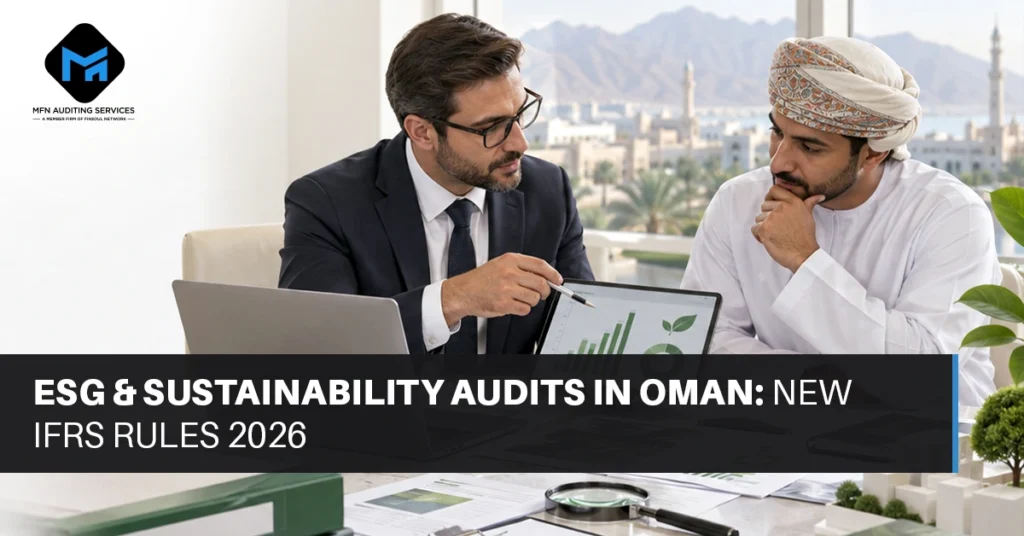
Oman’s corporate reporting landscape is changing fast. Just a few years ago, sustainability disclosure was voluntary and only a handful of listed companies bothered with it. Today it is a binding regulatory requirement, backed by the Financial Services Authority (FSA) and tied to global standards.
The shift is simple to sum up. An ESG sustainability audit in Oman is now becoming standard practice. Firms such as MFN Auditing are increasingly relevant as businesses strengthen ESG reporting, assurance, and internal controls ahead of the new requirements. Soon it will be reviewed with the same level of scrutiny as the annual financial statement audit.
This matters for more than just companies listed on the Muscat Stock Exchange (MSX). It affects how businesses collect emissions data, how boards oversee climate risk, how auditors are trained, and how investors judge Omani companies against regional competitors. This article explains what has changed, what the new IFRS rules require, and what businesses need to do next, whether they are listed or not.
How We Got Here: A Quick Timeline
Oman’s ESG rules did not appear overnight. They have built up steadily since 2023.
- 2023. The Capital Market Authority (CMA), through MSX, released Oman’s first ESG Disclosure Guidelines for public joint-stock companies (SAOGs). The guidelines cover 30 metrics across environmental, social, and governance areas, based loosely on GRI Universal Standards.
- 2024. MSX-listed companies were encouraged to report their 2023 ESG performance voluntarily, as a trial run before mandatory filing began.
- 2025. Administrative Decision 77/2025 made standalone ESG reporting compulsory for every SAOG listed on MSX. The first mandatory reports, covering 2024 activity, were due by 31 March 2025. By the end of the year, MSX confirmed that companies across the Main Market and Parallel Market had reached 100% compliance. Regulators saw this as proof that Omani boards were ready for a more technical phase.
- 2026. The FSA formally adopted the IFRS Sustainability Disclosure Standards, IFRS S1 and IFRS S2, through Decision E/7/2026. This shifted the conversation. It is no longer just about which ESG metrics to disclose. It is about how sustainability risks affect financial statements, and whether that information can be audited with the same rigor as a company’s accounts.
That last point explains why the 2026 rules matter so much. Oman is not simply adding another disclosure checklist. It is building sustainability reporting into the core financial reporting and audit framework.
What IFRS S1 and IFRS S2 Actually Require
The IFRS Sustainability Disclosure Standards come from the International Sustainability Standards Board (ISSB), the same body behind IFRS accounting standards. They were built to sit alongside financial statements, not as a separate “green report” on the side.
IFRS S1 sets the general baseline. It requires companies to disclose sustainability-related risks and opportunities that could reasonably affect cash flow, access to finance, or cost of capital, in the short, medium, and long term. This covers governance, strategy, risk management processes, and the metrics and targets used to track progress.
IFRS S2 narrows the focus to climate. Companies must disclose their governance and strategy around climate risk, their exposure to physical and transition risks, and their greenhouse gas emissions across Scope 1, Scope 2, and eventually Scope 3. It also asks how climate factors into financial planning and capital decisions.
The FSA’s rollout is phased and applies first to listed public joint-stock companies and FSA-regulated financial institutions:
- From 2027, the transition period begins. Companies should assess gaps, upgrade internal controls, and start building systems to collect reliable sustainability data.
- From 1 January 2029, IFRS S1 and IFRS S2 disclosures become mandatory for annual reporting periods starting on or after this date.
- From 1 January 2030, Scope 3 emissions disclosure becomes mandatory. Scope 3 covers indirect emissions across the value chain. The later start date reflects how hard it is to gather reliable data from suppliers, distributors, and customers.
This gives companies roughly three years to prepare before the standards apply, and one more year before the hardest part, Scope 3 reporting, kicks in. Regulators have linked the initiative to Oman’s Vision 2040 and its 2050 net-zero target, treating sustainability reporting as core market infrastructure rather than a side project.
Why This Changes the Nature of the Audit
Here is where the shift becomes real for finance and audit teams.
Under the current MSX guideline, disclosure works like a reporting exercise. Companies publish data against 30 metrics, and the exchange checks that the filing happened and, increasingly, whether the disclosure is good quality. IFRS S1 and S2 raise the bar. Sustainability information is meant to sit inside or alongside audited financial statements, which brings a much higher standard.
This creates three practical changes that audit services Oman firms and their clients should plan for now, not in 2029.
- Assurance becomes part of the deal. Financial auditors are used to testing numbers against source documents, controls, and estimates. Sustainability data, like emissions factors, energy use, and supply-chain estimates, has usually sat outside that process. It is often compiled by sustainability or HSE teams with little audit trail. Bringing this data into scope means auditors, or a specialist assurance provider, will need to test it properly: verifying source data, reviewing calculation methods, and checking internal controls over non-financial reporting systems.
- Governance and data systems become audit findings. IFRS S1 requires companies to disclose who oversees sustainability risk at board level, how often it is reviewed, and how it connects to pay and strategy. Weak governance, or data that cannot be traced back to its source, can now be flagged as a material weakness, not just a gap in disclosure.
- Materiality assessments need to hold up under scrutiny. IFRS S1 uses a “reasonably expected to affect” test, borrowed from financial reporting materiality. Companies that have treated ESG materiality as a stakeholder engagement exercise will need a more rigorous, financially grounded process that can survive an audit.
MSX Guidelines vs. IFRS S1/S2: Two Related but Different Frameworks
It helps to be clear on what sits where, since the two frameworks are often confused.
| MSX ESG Disclosure Guideline | IFRS S1 / S2 | |
| Basis | GRI-aligned, 30 metrics | ISSB global baseline |
| Status | Mandatory since 2025 | Mandatory from 2029 (phased from 2027) |
| Scope | All MSX-listed SAOGs | Listed companies and FSA-regulated financial institutions initially |
| Focus | Broad E, S, and G performance metrics | Financial materiality of sustainability and climate risk |
| Assurance expectation | Disclosure quality, reviewed by MSX | Audit-ready, similar rigor to financial statements |
Most companies will need to run both frameworks side by side for the next several years. MSX metrics satisfy exchange-level transparency rules. IFRS S1/S2 satisfies the financial materiality and assurance standards that come with international investors. Building data systems now that can serve both will save a costly second rebuild later.
Regional Context: Oman Is Not Moving Alone
Oman’s timeline fits into a wider GCC trend. Qatar’s central bank has already mandated IFRS S1 and S2 for banks and financial institutions, moving faster than most of the region. Saudi Arabia’s Tadawul introduced sustainability disclosure guidance back in 2021, and the UAE and Bahrain have similar requirements on their exchanges.
Oman’s approach, mandatory MSX metrics first and IFRS S1/S2 phased in over several years, is more gradual than Qatar’s. But it still pushes companies to modernize their reporting well before the 2029 deadline. For investors comparing options across the Gulf, consistent IFRS-aligned disclosure is quickly becoming the norm. Companies that fall behind risk being valued lower than regional peers.
What Businesses Should Be Doing Right Now
Waiting until 2028 to prepare for a 2029 deadline is a recipe for a rushed, weak first year of reporting. That is exactly what the phased timeline is designed to avoid. Based on how other GCC markets have handled similar transitions, here is a realistic starting point.
Run a gap assessment against IFRS S1 and S2 now. Compare what you already collect for the MSX’s 30-metric guideline against what the ISSB standards require. Find the real gaps. These are usually Scope 3 emissions, climate scenario analysis, and board-level governance documentation.
Build the data pipeline early. Sustainability data problems are rarely about willingness. They are about systems. Energy, water, and emissions data often sits in spreadsheets managed by operations or HSE teams, disconnected from finance’s control environment. Getting this data into an auditable system, with clear ownership and a traceable trail, is the single most valuable step a company can take in 2026 and 2027.
Bring finance and sustainability teams together. IFRS S1/S2 requires sustainability disclosures to link back to the financial statements: cash flow effects, asset impairment risk from climate exposure, and cost of capital impacts. A sustainability team working alone, disconnected from finance, cannot make that link. Neither can a finance team working without sustainability input.
Engage assurance providers early, not at year-end. Whether through the external auditor or a dedicated sustainability assurance engagement, having a provider review your data and controls now, well ahead of 2029, surfaces problems while there is still time to fix them.
Bring in ESG consulting Oman support where internal capacity is limited. Most Omani companies, even well-resourced ones, have not run an ISSB-aligned reporting cycle before. Specialist ESG consulting Oman advisors who understand both the FSA’s expectations and the technical detail of IFRS S1/S2 can shorten the learning curve. They can help with materiality assessments, governance frameworks, emissions methodology, and getting documentation audit-ready before the deadline pressure builds.
What IFRS Sustainability Standards Mean for Omani Businesses
It is easy to read all of this as a compliance burden. But the FSA and MSX have both said the goal is bigger than box-ticking. Full compliance with the MSX ESG guideline, and now the adoption of IFRS S1/S2, is being positioned as part of what makes Oman’s capital market attractive to international investors. These are investors who increasingly avoid companies that cannot produce comparable, assured sustainability data.
Regulators have tied the framework to Vision 2040 and net-zero 2050, but there is a near-term business case too. Companies with credible, audit-ready ESG reporting will find it easier to access capital, attract long-term investors, and defend their valuations against regional peers who got there first.
For Omani businesses, the takeaway is simple. The IFRS sustainability standards Oman has adopted are not a distant 2029 problem. The transition period starts in 2027, and building reliable data systems, governance structures, and audit-ready processes takes years, not months. Companies that start now, with the right internal alignment and the right external audit services Oman partners such as MFN Auditing helps businesses strengthen their reporting and assurance processes before the new requirements take effect.
Frequently Asked Questions
Does the IFRS S1/S2 deadline apply to all Omani companies, or just MSX-listed ones? The initial scope covers listed public joint-stock companies (SAOGs) and FSA-regulated financial institutions. Private companies are not directly covered by the 2029 deadline. Many will still feel pressure sooner, though, if they supply or partner with listed companies that need Scope 3 data ahead of the 2030 requirement.
Is the MSX ESG guideline being replaced by IFRS S1/S2?
No. The two frameworks work together. The MSX’s 30-metric, GRI-based guideline remains the mandatory disclosure format for listed companies. IFRS S1/S2 adds a financially focused, audit-ready layer on top, aimed mainly at investors and lenders assessing sustainability-related financial risk.
What happens if a company misses the disclosure requirements?
Under the current MSX framework, non-compliance can lead to regulatory warnings or escalation to the FSA. Once IFRS S1/S2 becomes part of the core financial reporting cycle from 2029, sustainability gaps are likely to be treated as seriously as financial reporting deficiencies, given their direct link to audited financial statements.
Where should a company start if it hasn’t begun preparing yet?
Start with a gap assessment against IFRS S1 and S2, using what you already collect for MSX reporting as a baseline. This shows exactly where the data, governance, and controls gaps sit before spending on new systems or advisory support.