
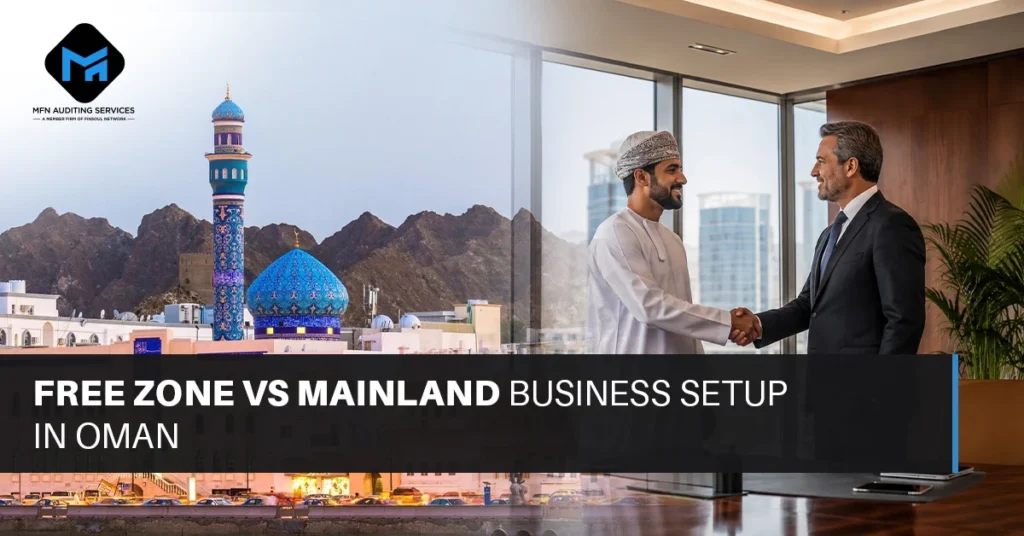
Oman has become one of the more attractive investment destinations in the Gulf, thanks to political stability, a growing logistics network, and a government committed to economic diversification under Vision 2040.
Two of the most common entry routes are mainland and free zone company formation. Both are well established, but they suit different business models, and your choice affects costs, operations, taxation, and future expansion. MFN Auditing compares both options, since rules under the Ministry of Commerce, Industry and Investment Promotion (MoCIIP) and the Public Authority for Special Economic Zones and Free Zones (OPAZ) vary by activity and jurisdiction.
Understanding Business Setup Options in Oman
Before comparing the two structures, it helps to understand what each one is and who they usually suit. A mainland company is registered under Omani commercial law and licensed to operate anywhere in the country, without being tied to a specific zone. It is regulated primarily by MoCIIP, along with relevant sector authorities. Mainland companies can trade directly with local customers, take on government contracts, and serve clients across all governorates, which suits businesses needing to be close to Omani consumers. Retailers, contractors, healthcare providers, and professional service firms usually choose a mainland setup because their revenue depends on local presence.
A free zone company is registered within a designated economic zone such as Sohar Free Zone, Salalah Free Zone, Duqm Special Economic Zone, or Al Mazunah Free Zone. These zones fall under OPAZ and attract export-oriented industries. Each zone has its own industry focus based on location, offering facilities and incentives tailored to sectors like petrochemicals, food processing, and heavy industry. Manufacturers, logistics firms, and traders commonly choose free zones when their business runs on trade flows, production, or warehousing rather than local retail.
Key Differences Between Free Zone and Mainland Business Setup
The table below summarises the core distinctions worth weighing before you decide.
| Feature | Mainland Company | Free Zone Company |
| Business jurisdiction | Anywhere in Oman | Within the designated zone |
| Foreign ownership | Depends on activity and sector rules | Often up to 100 percent, subject to zone rules |
| Business activities | Broad, including local trade and services | Manufacturing, logistics, trade, industry specific |
| Market access | Full domestic access | Primarily international |
| Office requirements | Commercial or retail premises | Flexi desks, warehouses, industrial land |
| Licensing authority | MoCIIP and sector bodies | OPAZ and the zone authority |
| Tax incentives | Standard corporate tax framework | Activity based incentives, subject to law |
| Customs benefits | Standard procedures | Duty exemptions on qualifying goods |
| Visa eligibility | Standard labour quotas | Often more flexible |
| Setup costs | Varies by activity and location | Varies by zone and facility type |
| Regulatory compliance | Commercial Registration and approvals | Zone specific compliance and lease terms |
| Expansion flexibility | Straightforward domestic growth | May need extra licensing to trade on mainland |
Mainland Business Setup in Oman
Mainland companies remain the default choice for many investors because of the flexibility they offer across almost every sector. A mainland licence gives access to the local market without the geographic limits of a free zone, letting companies open outlets in different governorates and serve individuals and businesses directly. Permitted activities span retail, construction, healthcare, education, hospitality, and professional services, letting companies add or adjust activities as they grow.
Mainland status also allows work with both government and private clients, including public tenders, which often becomes the deciding factor for businesses chasing local contracts.
Advantages of Mainland Companies
- Broader market access: Mainland companies can sell directly to Omani customers anywhere, without free zone trading limits.
- Greater operational flexibility: You are not tied to one zone or industry, making it easier to diversify over time.
- Ability to bid for local projects: Government and large private tenders often require mainland registration.
- Easier domestic expansion: Opening new branches across governorates is generally simpler than under a free zone licence.
- Strong local presence: Mainland registration builds trust with Omani clients who prefer locally established entities.
Potential Considerations
Mainland companies face standard regulatory approvals that vary by activity, including municipality permits, with regulated fields like healthcare needing extra clearance. Compliance obligations tend to be broader since mainland companies deal with multiple regulators, so confirm requirements for your exact activity before committing.
Free Zone Business Setup in Oman
Oman’s free zones were built to support export-driven and industrial businesses, and continue to expand under the diversification strategy. Sohar Freezone sits near a deep-sea port and has grown into a hub for metals and food processing. Salalah Free Zone focuses on logistics, chemicals, and renewable energy given its coastal location. Al Mazunah Free Zone, near the Yemen border, centres on trade and light industry, while Duqm Special Economic Zone is one of the largest in the region, covering energy, logistics, and heavy industry. Each zone has its own infrastructure suited to particular sectors, so the right zone depends on your specific activity, with the authority acting as a single point of contact for licensing.
Advantages of Free Zone Companies
- Potential 100 percent foreign ownership: Many free zone activities allow full foreign ownership, subject to zone rules.
- Customs and import/export benefits: Free zones often exempt or facilitate customs duties on qualifying goods.
- Strategic logistics locations: Zones like Duqm and Sohar are built around deep water ports with direct shipping access.
- Modern infrastructure: Purpose-built industrial land, warehousing, and utilities are generally available for operations.
- Streamlined registration: A single zone authority usually manages licensing, often shortening timelines.
- Sector-specific incentives: Some zones offer extended tax holidays and reduced Omanisation requirements early on.
Potential Considerations
Free zone companies often face restrictions on direct mainland trading, meaning they may need a local distributor to sell into the domestic market. Licensing is generally activity-specific, so a company approved for one operation may need extra approvals to diversify, and overall scope may be narrower than mainland.
Foreign Ownership Comparison
Ownership rules are often the deciding factor for foreign investors, and they differ between the two structures.
Mainland Companies
Oman’s ownership framework has generally moved toward allowing full foreign ownership for many mainland activities, though this depends on the activity and sector restrictions.
Activities tied to specific ministries, such as healthcare or education, often require extra clearance beyond standard Commercial Registration.
Free Zone Companies
Free zone companies are often associated with greater ownership flexibility, with many zones permitting full foreign ownership for eligible activities, though eligibility still depends on the zone.
Regulatory approvals are generally handled by OPAZ and the relevant zone authority, and activity-based restrictions can still apply to certain strategic sectors.
Business Activities Comparison
The type of activity you plan to run is often the biggest factor in choosing between mainland and free zone setup.
- Retail and hospitality: Physical stores and consumer-facing outlets generally need mainland registration to operate across locations.
- Professional services: Consulting, legal, and advisory firms often choose mainland status to serve clients throughout Oman.
- Construction and contracting: These sectors depend heavily on local project access, making mainland registration necessary.
- Healthcare and education: Consumer-facing sectors requiring proximity to the local population typically operate under mainland licences.
- Manufacturing: Production facilities benefit from industrial land, utilities, and customs advantages inside free zones.
- Logistics and warehousing: Companies moving goods internationally benefit from port proximity and streamlined customs.
- Import and export trading: Cross-border trading businesses often find free zone incentives directly relevant.
- Technology and R&D: Some zones are developing infrastructure to support innovation-driven sectors.
Licensing Process Comparison
Understanding the registration steps for each structure sets realistic expectations for setup timelines.
Mainland Registration Process
Setting up a mainland company follows a defined sequence, though timelines vary by activity.
- Select your business activity: This determines which regulations and licences apply from the start.
- Reserve your company name: A unique trade name must be reserved with the commercial registry.
- Apply for your licence and Commercial Registration: The application is submitted, then formalised through CR.
- Secure sector approvals: Municipality or ministry approvals may be needed before operations begin.
Free Zone Registration Process
Free zone registration is typically coordinated through a single zone authority, simplifying the process.
- Select the appropriate zone: Your choice should align with your industry and available infrastructure.
- Submit an investment proposal: The zone authority reviews your proposed activity, scale, and facility needs.
- Reserve your name and secure licence approval: Once accepted, proceed with name reservation and licensing.
- Sign a lease and complete incorporation: Free zone companies operate under lease arrangements, finalised by incorporation.
Tax Considerations
Tax treatment is often misunderstood, so approach this carefully rather than assuming automatic exemptions.
Corporate tax generally applies to companies based on income and activity, and mainland companies operate under the standard national framework. Free zone companies may benefit from incentives such as extended tax holidays, but this depends entirely on applicable law and how the activity is classified.
VAT and customs duty treatment also differ by structure, and free zone incentives are not automatic. Confirm your exact tax position with MoCIIP or a qualified advisor before finalising your structure.
Office and Facility Requirements
Physical presence requirements differ significantly between the two structures and can affect your setup budget.
Mainland
- Commercial office space: Most mainland activities require a registered office address suitable for the business.
- Retail or industrial premises: Consumer-facing or production activities need appropriately zoned space.
- Shared office options: Some activities may be permitted to operate from shared or serviced offices.
Free Zone
- Flexi desks and serviced offices: Smaller or early-stage companies can start with flexible, fully equipped arrangements.
- Warehouses and industrial land: Manufacturing and logistics companies can lease ready-built warehouses or raw plots.
- Built-to-suit facilities: Larger investors may negotiate custom facilities built around their production needs.
Employment, Visas, and Banking
Both structures follow Oman’s labour regulations, but visa allocation can differ. Mainland companies generally follow standard quotas tied to Commercial Registration and Omanisation rules, while free zones sometimes offer more flexible allocation early on to help new industrial businesses build their workforce.
Opening a corporate bank account requires your Commercial Registration or free zone licence, company documents, and activity details. Banks apply standard compliance checks on both structures, though free zone companies with heavy international dealings may need to show more trade detail.
Best Practices Before Choosing a Business Setup Option
- Define your target market: Decide whether your primary customers are local or international, since this shapes your structure.
- Evaluate business activities carefully: Confirm exactly what you plan to do, since this determines licensing rules.
- Compare long-term operating costs: Look beyond initial fees to ongoing rent, compliance, and visa costs.
- Seek professional business setup advice: Experienced consultants help you avoid missteps under current MoCIIP and OPAZ rules.
Conclusion
Both mainland and free zone company structures offer valuable opportunities for investors entering Oman, but they are built for different business models. Mainland companies suit businesses that depend on local market access, government contracts, and operational flexibility. Free zone companies suit businesses centred on international trade, manufacturing, and logistics, where customs benefits and industrial infrastructure matter most.
The right choice comes down to your target market, business activities, ownership preferences, tax position, and expansion plans. Since regulations vary by activity and jurisdiction, evaluate both options carefully and consult experienced professionals before deciding.
Ready to Set Up Your Business in Oman?
Choosing between a mainland and free zone structure is one of the most important decisions you will make as an investor in Oman. Our team can walk you through the current regulations and guide you through the entire registration process. Get in touch today to discuss your options with our advisors.
Reach out to us at
Email: info@mfnauditing.com
Phone: +968 7733 8545
Frequently Asked Questions
What is the difference between a mainland company and a free zone company in Oman?
A mainland company can operate anywhere in Oman and serve the local market directly, while a free zone company is registered within a specific zone and is generally oriented toward international trade or manufacturing.
Can a free zone company do business in the mainland?
In many cases, free zone companies face restrictions on direct mainland trading and may need a local distributor or extra licensing to sell into the domestic market.
Can foreigners own 100 percent of a mainland company?
Many mainland activities now allow full foreign ownership, but this depends on the specific activity, with some regulated industries requiring extra approvals.
Which option is better for SMEs?
There is no universal answer. Retail and service based SMEs often lean mainland, while trading or light manufacturing SMEs may prefer a free zone.
Are free zone companies exempt from corporate tax?
Not automatically. Some activities benefit from tax holidays, but this depends on applicable law and how the company’s activities are classified.