
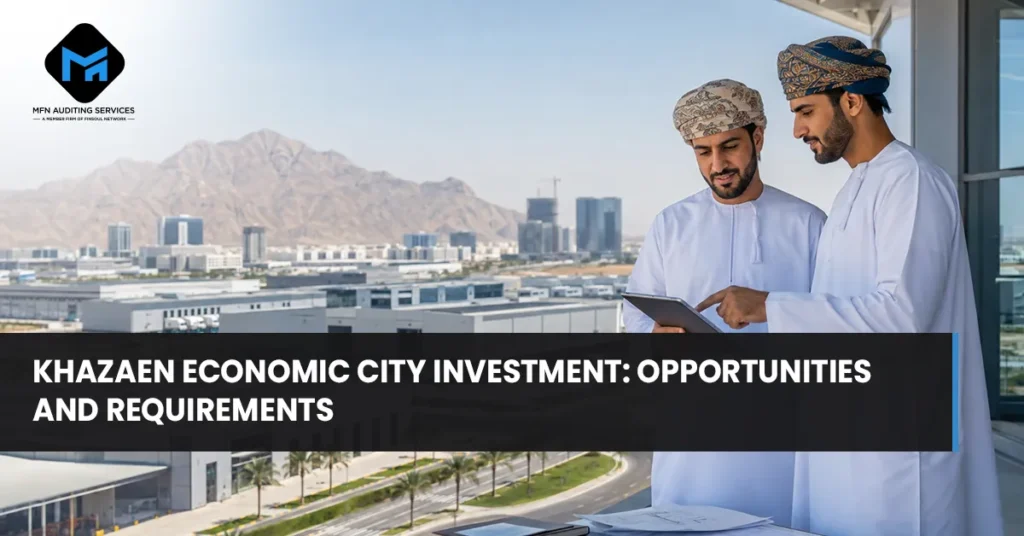
Khazaen Economic City sits in Barka along the Muscat-Batinah Expressway, giving it a direct link to the capital and the wider northern corridor of Oman. It has grown into an integrated logistics and industrial hub that combines industrial land, warehousing space, commercial areas and supporting infrastructure under one development. For investors, the real question is not just what Khazaen offers, but which type of business fits the location and what needs to be prepared before applying. This guide covers the opportunities, incentives, eligibility, documents, application steps, and practical costs an investor should know. Many businesses approach MFN Auditing at this early research stage to understand how the pieces fit together before committing capital.
What Makes Khazaen Economic City Different for Investors?
Khazaen is not a single industrial estate. It is planned as a full economic city with residential, commercial, industrial and logistics zones working together. This structure changes how an investor should think about location, supply chains and long-term expansion.
An Integrated City, Not a Standalone Zone
Khazaen brings industrial plots, logistics facilities, retail space and residential areas into one connected master plan. A manufacturer setting up here is not isolated from the workforce, suppliers or customers it needs day to day.
Connection to Muscat and the Road Network
Its position on the Muscat-Batinah Expressway puts Khazaen within reach of the capital’s ports, airport and consumer market. Businesses distributing goods across the north of Oman gain a shorter, more predictable route to their customers.
The Role of the Khazaen Dry Port
The Khazaen Dry Port gives logistics-focused businesses an inland point for container handling, customs processing and cargo movement. Companies importing raw materials or exporting finished goods can use it to reduce dependence on coastal port congestion.
Which Businesses Can Invest in Khazaen Economic City?
Khazaen accepts a wide range of activities across industrial, logistics, food, commercial and retail categories. The sections below break down where most current investment activity is concentrated.
Manufacturing and Industrial Projects
Light and medium manufacturing, assembly, packaging and repair operations make up a large share of Khazaen’s industrial base. Infrastructure-related manufacturing, such as producing materials used in construction, also fits well given the pace of regional development.
Logistics, Food and Commercial Activities
Warehousing, freight forwarding and distribution centres serving retail and wholesale customers. Cold storage, food storage and bulk handling for temperature-sensitive and construction goods. Corporate offices, finance and professional services, IT businesses and data centres.
Retail and Supporting Businesses
Supermarkets, hypermarkets and automotive dealerships serving the resident and worker population. Furniture businesses, wholesale and market-related activities alongside hospitality services.
What Are the Strongest Investment Opportunities in Khazaen in 2026?
Some sectors stand out from the general list because of current demand patterns and recent project activity inside the city.
Logistics and Warehousing
Storage and distribution demand keeps rising as more businesses move goods through northern Oman. Khazaen’s inland location, paired with the dry port, gives logistics operators an advantage over coastal-only facilities.
Food Processing and Cold Chain
Food security has become a national priority, and Khazaen’s centralised food ecosystem supports this directly. Demand for temperature-controlled storage continues to grow as more food businesses look for reliable inland options.
Industrial Manufacturing
Manufacturing localisation remains a focus for Oman, and Khazaen offers the industrial land and utility access needed to support it. Suppliers serving construction and infrastructure projects find a natural customer base close by.
Pharmaceutical Logistics and Construction Materials
Pharmaceutical warehousing and distribution infrastructure are growing categories within Khazaen, requiring controlled storage conditions and reliable logistics support. Cement-related products, pipes, infrastructure components and building materials continue to see steady demand too. A useful current proof point is that OPAZ reported four new Khazaen projects in 2026 with total investment exceeding OMR 12.8 million, including glue production, tile processing, infrastructure products, cement works and a pharmaceutical warehouse.
What Investment Incentives Does Khazaen Offer?
Khazaen’s incentive package covers land terms, ownership rules, tax treatment and operational support, and each category matters differently depending on the project type.
- Land and facility leases for up to 45 years, giving long-term certainty for large capital projects.
- The ability to sell buildings built on leased land, along with subleasing options subject to applicable terms.
- 24-hour operations along with an investor support team, worker accommodation and truck facilities.
Foreign Ownership and Business Control
Khazaen allows 100% foreign ownership of projects, which matters greatly to international investors who want full control over their Omani operation. The specific activity and applicable regulatory requirements should still be checked before assuming full ownership applies automatically. MFN Auditing is regularly asked to confirm ownership conditions for a specific activity before an application is submitted.
Tax and Customs Advantages
Khazaen states a five-year net-profit tax exemption for industrial projects, along with customs advantages relevant to the zone framework. Investors should verify the exact tax treatment that applies to their project structure, since this can vary based on the activity and current regulations.
Khazaen currently lists these incentives, including leases of up to 45 years, 100% foreign ownership, a five-year net-profit tax exemption for industrial projects, 24-hour operations and developed infrastructure.
What Are the Requirements for Khazaen Economic City Investment?
Preparing a strong application depends on having company, project and financial details organised in advance.
Company and Project Information
This includes the company name, Commercial Registration details where applicable, shareholder information and passport or identification documents for each investor. The project side should describe the proposed activity, land or facility size, estimated investment, expected capacity, required utilities, workforce numbers and an implementation timeline.
Financial and Supporting Documents
A feasibility study, business plan and bank statements are commonly requested, along with audited financial statements for corporate shareholders where required. Industrial projects also need manufacturing process and technology details included. Khazaen’s published application materials request company and shareholder information, CR documents, financial information, technology details for industrial projects, and supporting business-plan or feasibility-study documents.
What Documents Should You Prepare Before Applying?
A practical checklist helps avoid delays once the application process begins.
- Completed investment application along with Commercial Registration and company documents.
- Passport or identification documents and shareholder information for each investor listed.
- Audited financial statements and bank statements where applicable to the project structure.
- Business plan, feasibility study and manufacturing information for industrial projects.
- Project specifications, land and utility requirements, and any sector-specific approvals needed.
It helps to separate Khazaen application documents from Oman government licensing documents early on, since confusing the two stages is one of the more common reasons applications stall.
How Does the Khazaen Investment Application Work?
The process runs through four clear stages from submission to project start.
Step 1: Submit the Investment Application
The investor submits company, project and financial information as outlined earlier. A complete and accurate submission reduces back-and-forth requests and speeds up the timeline.
Step 2: Khazaen Reviews the Project
Khazaen states that its team evaluates the application within five working days, assessing the activity, land requirements and financial details against available plots and zone rules.
Step 3: Receive Land Allocation
Once approved, land is allocated according to the project’s nature and space requirements, matched to the appropriate cluster.
Step 4: Sign the Lease and Start the Project
The final step moves the project from a commercial agreement into implementation, with construction or fit-out work beginning based on the submitted timeline. The current Khazaen process is officially presented as investment application, land allocation, lease agreement and project commencement.
What Happens After Khazaen Approves the Investment?
Getting a site or lease from Khazaen is not the same as being fully authorised to operate a business in Oman.
- Company registration, commercial registration and investment licensing where applicable.
- Activity-specific and environmental approvals, construction approvals and utility connections.
- Labour and immigration requirements along with operational licences.
The Oman government currently states that investors subject to the Foreign Capital Investment Law must register for an investment licence after obtaining a Commercial Registration, and lists documents including a feasibility study, experience, bank statement and lease contract.
What Should Investors Check Before Choosing a Khazaen Plot?
Selecting the right plot affects daily operations and future expansion plans alike.
- Required land area and the choice between an industrial or logistics-focused location.
- Road access, distance to the dry port, and power, water, fibre and telecom availability.
- Waste management, environmental requirements and storage needs specific to the activity.
- Expansion potential, workforce accommodation, and truck movement or loading requirements.
Khazaen Economic City vs Other Oman Investment Locations
Choosing between Khazaen and other zones comes down to what the project actually needs from its location.
Khazaen vs Sohar and Duqm
Khazaen sits closer to Muscat and focuses more on inland logistics, industrial and warehousing activity, while Sohar and Duqm lean toward port-linked heavy industry. Their distance from Muscat makes them less practical for businesses needing frequent access to the capital and its consumer market.
Khazaen vs Salalah
Salalah offers a different logistics geography with its own port access, particularly for businesses trading with East Africa and South Asia. Khazaen instead serves businesses focused on the domestic Omani market and inland logistics.
Choose Khazaen when proximity to Muscat, inland logistics, warehousing, manufacturing and domestic market access are central to the project. Choose one of the other zones when deep-sea port access or a specific export corridor matters more.
What Mistakes Can Delay a Khazaen Investment Application?
Most delays come from avoidable gaps in preparation rather than eligibility issues. MFN Auditing sees the same handful of gaps come up repeatedly during application reviews.
- Submitting incomplete company documents or unclear project descriptions that trigger follow-up requests.
- Underestimating land requirements or skipping a credible feasibility study before applying.
- Ignoring utility requirements or choosing an unsuitable activity classification.
- Assuming the Khazaen lease is the only required approval, or skipping environmental checks.
- Underestimating construction and working capital needs, or starting the project before licences are complete.
Khazaen Economic City Investment: Key Requirements at a Glance
| Requirement | What the Investor Should Prepare |
| Business activity | Clear description of proposed activity |
| Company details | CR and corporate documents |
| Shareholders | ID/passport and ownership details |
| Financial capacity | Bank statements/financial records where required |
| Project feasibility | Business plan and feasibility study |
| Industrial projects | Manufacturing process and technology details |
| Land | Required area and proposed use |
| Utilities | Power, water, telecom and other requirements |
| Licensing | Relevant Oman government approvals |
| Lease | Khazaen lease agreement after allocation |
Conclusion: Is Khazaen Economic City a Good Investment Location?
Khazaen brings together logistics, manufacturing, warehousing and food-related opportunities in one connected city near Muscat. The combination of developed infrastructure, long-term lease terms, foreign ownership provisions and an active investor pipeline makes it a genuinely competitive option for regional and international investors alike. That said, land selection, licensing, realistic cost planning and project requirements all need proper assessment before committing capital to any plot. Working with MFN Auditing at the planning stage can help investors move from application to operation with fewer delays and a clearer picture of what each step actually requires.
Ready to Invest in Khazaen Economic City?
Planning to invest in Khazaen Economic City? Get professional assistance with company registration, investment licensing, documentation, approvals and the setup process so your project can move from application to operation with fewer delays.
Contact MFN Auditing today to discuss your project requirements and get support at every stage of the process.
Email: info@mfnauditing.com
Frequently Asked Questions About Khazaen Economic City Investment
Can foreigners invest in Khazaen Economic City?
Yes. Khazaen currently offers 100% foreign ownership for approved projects, though the applicable regulatory conditions for the specific activity should always be confirmed before applying.
What businesses can be established in Khazaen Economic City?
Manufacturing, logistics, warehousing, food processing, business services, retail and several other approved activities can all be established, depending on the cluster and land available.
How do I apply for investment in Khazaen Economic City?
The process runs through submitting the investment application, Khazaen’s review, land allocation, and finally signing the lease before construction or operations begin.
What documents are needed for a Khazaen investment application?
Company and shareholder documents, financial records, a business plan or feasibility study, and manufacturing or technology details for industrial projects make up the core requirements.
How long does Khazaen take to review an investment application?
Khazaen states that its team evaluates applications within five working days, though the overall project timeline still depends on land allocation, agreements, licensing and implementation afterward.