
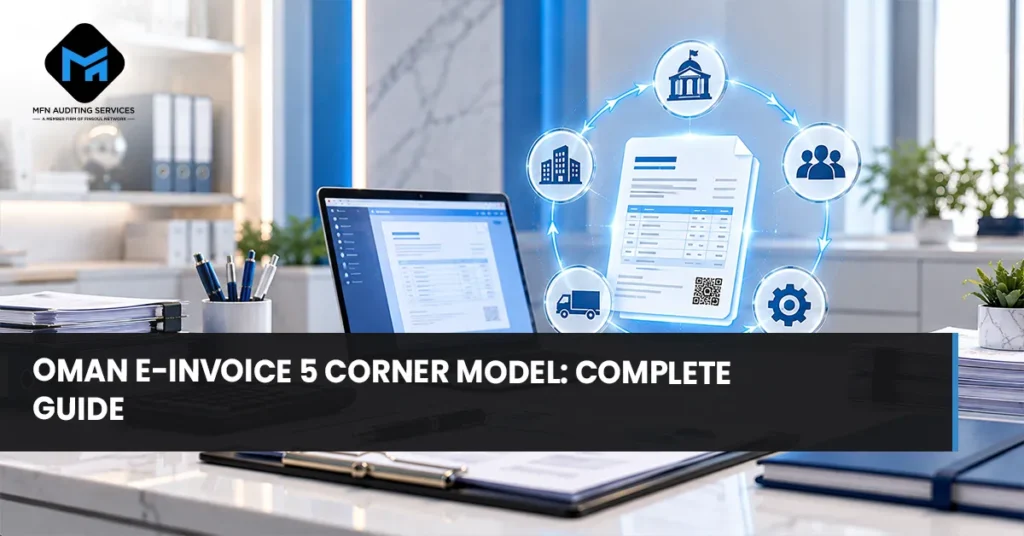
Oman is moving from paper and PDF invoices to a fully structured, network-based system, and the E-Invoice 5 Corner Model sits at the centre of that shift. Under the national programme known as Fawtara, invoices will no longer travel as email attachments between two companies; they will move through accredited service providers on a Peppol-based network, with the Oman Tax Authority receiving the tax data as part of the same flow.
For finance teams, this is a bigger change than it first appears. It affects how invoices are created, what data must be present, which systems must talk to each other, and how quickly transactions become visible to the Tax Authority. This guide explains what the E-Invoice 5 Corner Model is, how each corner works, the rollout phases businesses in Oman need to plan around, and the practical steps to be ready before their phase begins.
MFN Auditing helps businesses understand and prepare for these changes by focusing on the accounting, compliance, and audit implications of Oman’s transition to structured e-invoicing.
What Is the E-Invoice 5 Corner Model?
The E-Invoice 5 Corner Model is an invoice exchange framework in which two trading parties, their two service providers, and the tax authority each play a defined role. It builds on the widely used Peppol four-corner network by adding the tax authority as a fifth participant that receives invoice data as part of the normal exchange.
The important idea is that compliance stops being a separate reporting task. Instead of issuing an invoice and then filing information about it later, the invoice itself carries the tax data through the network, and the authority receives what it needs from the same transmission. That is why the model is often described as continuous transaction control rather than traditional post-audit reporting.
- Structured data, not documents: Invoices are exchanged as machine-readable XML files rather than PDFs or scans.
- Network-based delivery: Accredited providers handle transmission, so businesses do not connect directly to every counterparty.
- Built-in validation: Invoices are checked against technical and business rules before they reach the buyer.
- Authority visibility: Tax data reaches the Oman Tax Authority as part of the exchange, not as a separate submission.
How the Model Fits Into Oman’s Fawtara Programme
Fawtara is Oman’s national e-invoicing initiative, and the Oman Tax Authority became the country’s Peppol Authority in January 2026. That role gives the OTA responsibility for setting national requirements, accrediting service providers, and maintaining alignment with Peppol standards.
Oman also published its national specification, PINT OM, which adapts the international Peppol PINT standard to local requirements. Alongside the specification, the OTA operates a centralised Service Metadata Publisher, which means accredited providers register participants through the OTA’s infrastructure rather than running independent directories.
Understanding the Five Corners
Each corner in the model has a clearly defined job. Understanding these roles makes it much easier to see where your business responsibilities begin and end.
Corner One: The Supplier
The supplier creates the invoice in its own accounting system or ERP and generates it in the required structured format. This is where most of the internal work sits, because the invoice must contain every mandatory field in a valid form before it can be transmitted.
Corner Two: The Supplier’s Accredited Service Provider
The supplier’s provider receives the invoice, validates it against technical schema rules and Omani business rules, and then transmits it onward. Where an invoice fails validation, it is rejected back to the supplier rather than being delivered, which is why data quality matters so much.
Corner Three: The Buyer’s Accredited Service Provider
The buyer’s provider receives the validated invoice from the network and delivers it into the buyer’s environment. Because both providers work to the same national specification, the buyer receives a predictable file structure regardless of which system the supplier uses.
Corner Four: The Buyer
The buyer receives a machine-readable invoice that can flow directly into accounts payable, matching, and approval workflows. This is where the commercial benefit of the model appears, since manual data entry and re-keying largely disappear.
Corner Five: The Oman Tax Authority
The fifth corner is the OTA, which receives the relevant tax data from the transaction. This visibility supports VAT verification, return pre-population over time, and far more targeted audit activity than manual sampling allows.
Four Corners Versus Five Corners: What Actually Changes
Many businesses have heard of Peppol’s four-corner model through European trading partners. The Omani model keeps that architecture and extends it, so the differences are worth stating plainly.
The table below highlights the key differences between the traditional Four Corner Model and Oman’s E-Invoice 5 Corner Model:
| Aspect | Four Corner Model | E-Invoice 5 Corner Model |
| Participants | Supplier, two providers, buyer | The same four, plus the tax authority |
| Tax authority role | Outside the exchange | Receives tax data within the flow |
| Reporting | Separate periodic filings | Data reported as part of transmission |
| Validation focus | Interoperability and format | Format plus national tax rules |
| Audit approach | Post-audit review of records | Continuous transaction control |
How an Invoice Moves Through the Network
The end-to-end journey is straightforward once the roles are clear, and it happens in seconds rather than days.
- Step one: The supplier generates a structured invoice in the PINT OM format from its billing system.
- Step two: The invoice is submitted to the supplier’s accredited service provider, usually through an API integration.
- Step three: The provider validates the file, and either rejects it with error details or accepts it for delivery.
- Step four: The invoice is routed across the network to the buyer’s accredited service provider.
- Step five: The buyer receives the invoice in machine-readable form for automated processing.
- Step six: The associated tax data reaches the Oman Tax Authority for compliance purposes.
Oman E-Invoicing Rollout Phases
The mandate is being introduced in waves rather than all at once, which gives businesses outside the first group time to prepare. The published roadmap follows the sequence below.
| Phase | Timing | Who Is Covered |
| Sandbox testing | February 2026 | Service providers and pilot participants |
| Provider accreditation | May 2026 | Service providers seeking OTA accreditation |
| Phase One | August 2026 | A selected first wave of large VAT-registered taxpayers |
| Phase Two | February 2027 | All remaining large VAT-registered taxpayers |
| Phase Three | August 2027 | All other VAT-registered taxpayers |
| Phase Four | Expected 2028 | Government entities and public bodies |
Businesses should confirm their own phase and any notification received from the Tax Authority, since selection for the first wave is based on OTA criteria rather than self-assessment. Companies that trade heavily with first-wave customers will feel the change earlier than their own phase date suggests, because those customers will expect structured invoices from their suppliers.
Which Transactions Are In Scope
Scope is broader than many businesses initially assume, and it is defined by VAT registration rather than company size alone.
- Business to business: Domestic B2B invoices between VAT-registered parties sit at the core of the mandate.
- Business to government: B2G transactions are included as public entities are brought into the programme.
- Business to consumer: B2C sales are covered, with reporting to the authority permitted within a short window rather than instantly.
- Exports and imports: Cross-border transactions require careful mapping, as they follow specific handling rules.
- Credit and debit notes: Adjustment documents follow the same structured process as the original invoice.
Sellers who are not registered for VAT remain outside the network, but they still receive structured invoices from suppliers who are inside it.
Formats and Technical Requirements
Oman’s specification is built on established international standards, which reduces the work for businesses already trading with Peppol markets.
- PINT OM Billing: The main document type covering invoices, credit notes and debit notes.
- PINT OM Self-Billing: Used where the buyer issues the invoice on the supplier’s behalf under an agreed arrangement.
- Tax Data Document: A reporting document that carries transaction data to the Tax Authority, validated in its own right.
- UBL 2.1 XML: The underlying syntax, aligned with Peppol and the EN 16931 European semantic standard.
- QR codes for B2C: Human-readable consumer invoices must display a QR code alongside the structured record.
- Archiving: Structured records must be retained securely for the required retention period, in a form that remains readable and retrievable.
Choosing an Accredited Service Provider
Businesses cannot connect to the network unaided; transmission runs through providers accredited by the OTA. Accreditation criteria are demanding, which is a good sign for reliability but narrows the field of genuine options.
- Local presence: Providers need commercial registration in mainland Oman, with a local establishment required for foreign or GCC entities.
- Financial standing: A minimum paid-up capital requirement applies, alongside clean insolvency and criminal records.
- Security certification: ISO/IEC 27001 certification and controls such as multi-factor authentication, encryption and monitoring are expected.
- Technical capability: Providers must demonstrate operational experience and reliable integration support.
When comparing providers, look beyond price at integration options for your ERP, error-handling and reprocessing tools, support hours in Omani time, and whether they can handle your full transaction mix including exports, self-billing and high-volume B2C.
What Changes Inside Your Business
The technical connection is only part of the project. Most of the effort sits in data, process and people, and this is where timelines usually slip.
Master Data and Invoice Content
Every mandatory field must be present and correctly formatted, including tax identifiers, item descriptions, tax categories and totals. Customer and supplier master records that were good enough for PDF invoicing frequently fail structured validation, so a data cleansing exercise should start early.
Systems and Integration
Your ERP or billing system must be able to generate structured output and receive responses from the provider. Where a system cannot produce compliant XML directly, a middleware layer or provider-side conversion becomes necessary, and both options need testing under realistic volumes.
Process and People
Finance, IT, procurement and sales teams all touch the invoice lifecycle, and each needs to understand what a rejection means and how to resolve it. Accounts payable processes also change, since incoming invoices arrive as data rather than documents and can be matched automatically.
Benefits Beyond Compliance
Meeting the mandate is the immediate driver, but the operational gains are real and worth building into the business case.
- Faster processing: Automated receipt and matching remove manual data entry from both sides of the transaction.
- Fewer disputes: Validated, structured data reduces mismatches in prices, quantities and tax treatment.
- Better cash flow visibility: Invoices arrive immediately, giving clearer visibility of payables and receivables.
- Lower audit friction: Consistent, complete records make tax reviews faster and less disruptive.
- Reduced cost per invoice: Printing, posting, scanning and archiving costs fall significantly at volume.
Common Mistakes to Avoid
Experience from other markets that adopted similar models points to a predictable set of problems, most of which are avoidable.
- Treating it as an IT project: Without finance and tax ownership, the output may be technically valid but incorrect in tax terms.
- Starting too late: Provider selection, integration and testing routinely take longer than planned, particularly with legacy systems.
- Ignoring master data: Incomplete customer records are the single most common cause of invoice rejection.
- Overlooking edge cases: Exports, imports, reverse charge, self-billing and credit notes need explicit mapping.
- Forgetting the receiving side: Preparing only to issue invoices leaves accounts payable unable to process what arrives.
- Assuming a later phase means no action: Customers in earlier phases will change how they expect you to invoice them.
Preparation Roadmap
A structured approach keeps the project manageable and reduces the risk of a last-minute scramble before your phase date.
- Assess: Map every transaction type, invoice volume and system involved in billing today.
- Clean: Review and correct customer, supplier and item master data against mandatory field requirements.
- Select: Shortlist accredited service providers and confirm integration approach and costs.
- Build: Configure or upgrade systems to produce and receive compliant structured documents.
- Test: Use the sandbox environment and provider testing to validate real transaction scenarios.
- Train: Prepare finance, IT and commercial teams for new workflows and exception handling.
- Go live: Run a monitored transition with clear escalation routes for rejected invoices.
Conclusion
The E-Invoice 5 Corner Model changes the relationship between businesses and the Tax Authority from periodic reporting to continuous, structured visibility. For companies in Oman, that means invoice accuracy is no longer something that can be corrected quietly at month-end; it must be right at the moment of issue.
The businesses that handle this well will be the ones that start early, treat data quality as the foundation, and involve finance and IT together rather than sequentially. MFN Auditing can help businesses approach this transition with a clear focus on compliance, readiness, and practical implementation.
The wider opportunity is worth keeping in view. Structured invoicing is a chance to remove manual work from finance operations, shorten payment cycles, and build cleaner records that make every future audit and financing conversation easier.
Get Expert E-Invoicing Support Today
Preparing for Oman’s e-invoicing mandate touches your systems, your data, and your day-to-day finance processes at the same time. MFN Auditing works with businesses across Oman to assess readiness, map transaction scenarios, and build a practical implementation plan ahead of each phase deadline.
Reach out today to get personalised guidance for your business.
Email: info@mfnauditing.com
Phone: +968 7733 8545
Frequently Asked Questions
What is the E-Invoice 5 Corner Model in simple terms?
It is an invoicing framework where the supplier, the buyer, their two accredited service providers, and the tax authority each have a defined role. The invoice travels through the network while the relevant tax data reaches the authority as part of the same process.
How is it different from the four-corner model?
The four-corner model connects two trading parties through two service providers. The five-corner model adds the tax authority as a fifth participant, so compliance data flows with the transaction rather than through separate filings.
When does e-invoicing become mandatory in Oman?
The rollout begins in August 2026 for a selected first wave of large VAT-registered taxpayers, extends to all large taxpayers in February 2027, and covers remaining VAT-registered taxpayers in August 2027, with government entities following later.
Do small businesses need to comply?
VAT-registered businesses are brought in during the later phases, so smaller registered companies should plan for the 2027 timeline. Businesses that are not VAT registered are outside the network but will still receive structured invoices from suppliers who are inside it.
Can we send e-invoices directly to the Tax Authority ourselves?
Invoices are exchanged through accredited service providers rather than direct submission, so selecting an accredited provider is a required step. The provider handles validation, transmission, and the reporting route to the authority.
What format must Omani e-invoices use?
Invoices follow the PINT OM specification based on UBL 2.1 XML, aligned with Peppol standards. Consumer-facing invoices must also carry a QR code on the human-readable version.