Author name: usman

ERP Solution in Oman

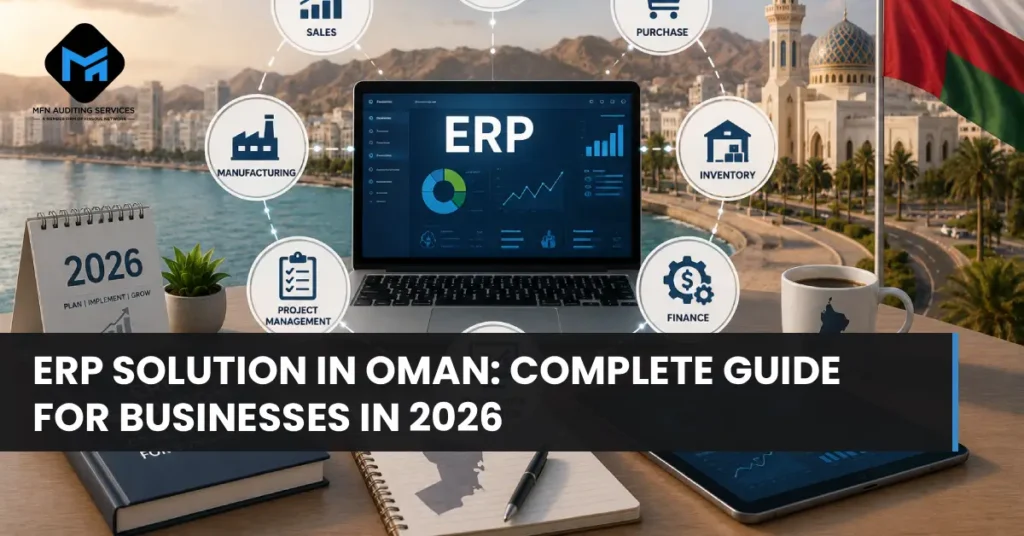
ERP Solution in Oman: Complete Guide for Businesses in 2026

Businesses across Oman are rethinking how they manage operations. Manual processes, disconnected software, and fragmented data are limiting growth at a time when the market demands speed, accuracy, and agility. Digital transformation is no longer a long-term ambition for most companies; it is a practical necessity driven by competition, regulation, and rising customer expectations. Enterprise Resource Planning (ERP) solutions sit at the centre of this shift. Organisations across manufacturing, construction, retail, logistics, and professional services are replacing legacy systems with integrated ERP platforms to gain control over their operations and make faster, better-informed decisions. MFN Auditing covers everything businesses in Oman need to know about ERP solutions in 2026, from how they work and what they include to how to choose the right system and implement it effectively. What Is an ERP Solution? Enterprise Resource Planning is a category of business management software that integrates core operational functions into a single, connected platform. Finance, inventory, procurement, sales, human resources, and production all share a unified database, giving every department access to the same real-time information. ERP is often confused with CRM or accounting software. A CRM manages customer relationships and sales activity. Accounting software handles financial transactions. ERP does both and connects them with every other function in the business, from warehouse management to payroll to project costing. The result is a single source of truth across the entire organisation. For modern businesses, operating without an ERP system typically means managing multiple disconnected tools, re-entering data across platforms, and making decisions based on information that is already out of date. Why Businesses in Oman Are Investing in ERP Solutions Several forces are accelerating ERP adoption across Oman. Oman Vision 2040 places digital transformation at the centre of the country’s economic development strategy. Businesses investing in technology infrastructure are better positioned to participate in the diversified economy Vision 2040 is building, particularly in manufacturing, logistics, tourism, and knowledge-based industries. Growing competition across sectors is compressing margins and raising the bar for operational performance. Businesses that rely on manual processes and disconnected systems are slower to respond, more prone to errors, and harder to scale. Regulatory compliance and reporting requirements have become more structured. Managing VAT obligations, financial reporting, and industry-specific compliance manually carries increasing risk. ERP systems automate compliance tracking and generate the documentation regulators require. Real-time business insights have become a competitive advantage. Businesses with integrated ERP platforms can monitor performance, identify problems, and act on opportunities faster than those working from weekly spreadsheets and monthly reports. How an ERP System Works Centralised Database All business data, from invoices and stock levels to employee records and customer orders, is stored in a single database. Every department accesses and updates the same information, eliminating duplication and ensuring consistency across the organisation. Automation of Business Processes Routine tasks such as purchase order generation, invoice processing, payroll calculations, and stock reordering are automated based on predefined rules. This reduces manual effort, accelerates workflows, and removes a significant source of human error. Real-Time Reporting and Analytics Because all data flows into a single system, reports reflect the current state of the business rather than a snapshot from the last manual export. Managers can access live dashboards covering financial performance, inventory levels, sales activity, and operational KPIs at any time. Integration Across Departments Actions in one department trigger automatic updates in others. A confirmed sales order updates inventory, triggers procurement if stock is low, and feeds into the finance module for invoicing. Information flows across the business without manual handoffs. Workflow Management ERP systems allow businesses to define approval workflows, escalation paths, and process controls. Purchase orders above a threshold require authorisation. Expenses follow a defined approval chain. Processes are governed by the system, not by informal practice. Key Features of a Modern ERP Solution Financial Management A robust ERP finance module covers the general ledger, accounts payable, accounts receivable, budgeting, and financial reporting. Businesses can manage multi-currency transactions, generate VAT-compliant reports, and maintain audit-ready financial records without manual consolidation. Inventory and Warehouse Management Real-time stock tracking, barcode integration, and automated inventory forecasting give businesses accurate visibility over their supply chain. Overstocking and stockouts both carry cost; ERP helps find the balance. Procurement and Purchasing Supplier management, purchase order generation, and vendor performance tracking are centralised within the ERP. Procurement teams can compare supplier pricing, track delivery performance, and manage the full purchase-to-pay cycle in one place. Sales and CRM Customer records, sales pipelines, quotations, and invoicing are managed within the same platform. Sales teams have full visibility over account history, outstanding orders, and customer communication without switching between tools. Human Resource Management (HRMS) Payroll processing, attendance tracking, leave management, and employee records are handled within the ERP. For businesses in Oman managing Omanisation ratios and WPS payroll compliance, an integrated HRMS significantly simplifies administration. Manufacturing Management Production planning, Bill of Materials (BOM) management, and quality control are essential for manufacturing businesses. ERP connects the shop floor to the finance and procurement modules, giving management a complete view of production costs and output. Project Management For construction, engineering, and professional services firms, project-based ERP functionality covers resource planning, cost tracking, and project scheduling. Budget versus actual comparisons are available in real time rather than at month end. Business Intelligence and Reporting Custom dashboards, KPI monitoring, and configurable reports allow management to track performance against targets across every function. Data that previously required days of manual extraction is available on demand. Benefits of ERP Solutions for Businesses in Oman ERP systems are more than just software; they are strategic tools that streamline operations and strengthen customer service. For Omani businesses, ERP investment delivers measurable improvements across efficiency, compliance, and growth. Improved Efficiency: Eliminates redundant manual processes, reduces duplicate data entry, and integrates disconnected systems for smoother workflows. Better Decision‑Making: Real‑time data visibility supports informed, faster decisions across departments. Higher Productivity: Employees spend less time on administrative tasks and more on value‑adding work. Enhanced Customer Service: Account teams access complete, up‑to‑date information, improving responsiveness and client

ERP Solution in Oman: Complete Guide for Businesses in 2026 Read More »

Commercial Registration Certificate in Oman

How to Obtain a Commercial Registration Certificate in Oman: Complete Step-by-Step Guide

Starting a business in Oman begins with one essential legal step: obtaining a Commercial Registration (CR) Certificate. Whether you are an Omani entrepreneur launching a new venture, a foreign investor entering the market, or an established company opening a branch office, the CR is the foundation of your legal identity in Oman’s commercial landscape. Without a valid CR, a business cannot open corporate bank accounts, enter into formal contracts, apply for licences, or participate in government tenders. In 2026, the process has been significantly streamlined through the Oman Business Platform, making registration more accessible and efficient than ever before. MFN Auditing covers every stage of the process, from eligibility and documentation through to receiving your certificate and staying compliant. What Is a Commercial Registration (CR) Certificate in Oman? A Commercial Registration Certificate is an official government document that legally recognises a business as a registered commercial entity in Oman. It records the business name, legal structure, registered activities, shareholder details, and registered address, serving as the business’s legal identity for all regulatory and commercial purposes. The Ministry of Commerce, Industry and Investment Promotion (MOCIIP) issues the CR through the Oman Business Platform. Every business operating commercially in Oman is legally required to hold a valid CR. Operating without one exposes the entity to financial penalties, forced closure, and ineligibility for contracts and government approvals. It is important to note that the CR is distinct from a business licence. The CR establishes who the business is, while the licence authorises what the business may do. Most businesses require both before commencing operations. Who Needs a Commercial Registration Certificate? The CR requirement applies broadly across entity types and ownership structures. The following categories all require a valid CR before operating in Oman. Omani entrepreneurs setting up sole proprietorships, LLCs, or general partnerships. Foreign investors establishing wholly foreign-owned companies or joint ventures under the Foreign Capital Investment Law. SMEs and startups across all sectors, regardless of size or revenue. Branch offices of foreign companies registered to operate in Oman. Professional firms, trading companies, industrial entities, and technology ventures. In short, if a business conducts any commercial activity in Oman, it requires a CR. The specific documentation and fee requirements vary by entity type, but the registration obligation is universal. Benefits of Obtaining a Commercial Registration Certificate Beyond meeting a legal requirement, the CR unlocks a range of practical and commercial benefits that are essential for doing business in Oman. Legal recognition: The CR establishes the business as a recognised legal entity capable of entering into contracts and issuing invoices. Corporate bank accounts: Banks in Oman require a valid CR before opening any business account. Government approvals and tenders: Public sector contracts and ministry approvals are inaccessible without a CR on file. Import and export activities: Customs authorities require a CR for commercial clearances. VAT registration: The Tax Authority requires a valid CR as part of the VAT registration process. Investor and customer trust: A registered business signals credibility and regulatory compliance to partners, clients, and investors alike. Eligibility Requirements for Obtaining a Commercial Registration Certificate  For Omani Nationals Omani citizens can register as sole proprietors or through partnership and corporate structures. Sole proprietors must be at least 18 years of age. LLCs require a minimum of two shareholders unless registering as a Single Person Company, which is available to Omani nationals. For Foreign Investors Following amendments to the Foreign Capital Investment Law, foreign investors can now own 100 percent of a business in most sectors. However, certain restricted activities still require Omani participation or a minimum Omani shareholding percentage. Foreign investors must hold a valid residency visa or entry permit where applicable, and a registered legal address in Oman is required for all entities. Business Activity Requirements The business activity must appear on MOCIIP’s approved list of commercial activities. Regulated activities such as healthcare, education, financial services, and telecommunications require prior approval from the relevant ministry or authority before the CR can be finalised. Trade Name Availability The proposed business name must be unique, must not conflict with existing registered entities, and must not include prohibited words or terms. MOCIIP’s name reservation system, accessible through the Oman Business Platform, allows applicants to check availability and reserve a name before submitting the registration application. Documents Required for Commercial Registration Preparing the correct documentation before submission significantly reduces delays. The following are required for most registrations. Valid Omani national identity card for Omani shareholders, or a valid passport for foreign shareholders. Residency visa or entry permit for foreign nationals residing in Oman. Shareholder details including full names, nationalities, and shareholding percentages. Proposed trade name confirmation following successful reservation. Proof of registered business address, typically a commercial lease agreement or property ownership document. Articles of Association for LLCs and partnerships, prepared and notarised by a licensed notary. Regulatory approval letters for activities in restricted or regulated sectors. For foreign-owned companies: parent company registration documents and a board resolution authorising establishment of the Oman entity, both attested and translated into Arabic where required. Step-by-Step Process to Obtain a Commercial Registration Certificate in Oman To legally operate a business in Oman, you must secure a Commercial Registration (CR) Certificate from the Ministry of Commerce, Industry, and Investment Promotion (MOCIIP). This certificate is your company’s legal identity, enabling access to banking, property leasing, employee visas, and government tenders. Step 1: Choose Your Business Activity Begin by identifying the commercial activity you intend to conduct and locating its corresponding code in MOCIIP’s classified activity list. Selecting the correct activity code determines which regulatory approvals are required and which authority has oversight of your sector. Step 2: Select the Appropriate Legal Structure Choose the legal structure that best suits your ownership arrangements, liability preferences, and business objectives. Common structures include the Limited Liability Company (LLC), Sole Proprietorship, General Partnership, and Single Person Company. Each carries different capital, liability, and ownership requirements, so this decision should be made carefully and ideally with professional guidance. Step 3: Reserve a Business Name Submit

How to Obtain a Commercial Registration Certificate in Oman: Complete Step-by-Step Guide Read More »

Accounting Consultant

Why Your Business Needs an Accounting Consultant in Oman

Many businesses in Oman look successful on the outside, yet serious financial problems quietly grow behind the scenes. Cash flow becomes difficult to manage. VAT deadlines create stress. Financial reports stay incomplete, and business owners struggle to understand where profits actually go. Small accounting mistakes slowly turn into costly decisions. That pressure increases even more as the business grows. MFN Auditing supports businesses in Oman by turning financial confusion into clear direction. Expert guidance helps companies manage reporting, stay aligned with VAT rules, and understand real financial performance in simple terms. Better control over numbers brings stronger planning and fewer mistakes. That is how businesses move forward with more confidence and stable growth. What Does an Accounting Consultant Actually Do? Many business owners think accounting consultants only record numbers, but the role goes far beyond basic bookkeeping. An accounting consultant studies business finances in detail, checks financial reports, and spots gaps that can affect profit. Cash flow becomes clearer when proper analysis is done, and expense control improves over time. A better understanding of numbers helps owners make stronger financial decisions without confusion.  Consultants also support VAT work, audit preparation, and compliance needs in Oman. Financial mistakes that often stay hidden in daily operations get identified early. Business owners gain clearer direction and more control over planning. Simple reporting and practical advice help companies manage growth in a stable way and reduce financial pressure in day-to-day operations. Top Signs Your Business Needs an Accounting Consultant Many businesses in Oman keep running for years without realizing their finances are slowly becoming unbalanced. Problems do not appear all at once. They build up quietly through small gaps in records, planning, and reporting. At some point, the pressure becomes hard to ignore, and daily decisions start feeling uncertain. That is often the moment where accounting support becomes important for stability and control. Cash Flow Problems Cash may look fine on paper, yet the reality feels different. Payments come late, expenses move fast, and planning gets difficult. This creates constant pressure on daily operations. An accounting consultant helps track money movement in a clear way so business owners can see what is actually happening behind the numbers. VAT Filing Confusion VAT rules can feel complicated for many business owners. Small errors in filing or missing records often create stress during reporting periods. Consultants help organize data properly and reduce mistakes that can lead to penalties or delays. Rapid Business Growth Growth sounds positive, but it brings financial pressure too. More clients, more expenses, and more transactions can quickly become hard to manage without proper systems. Financial guidance helps bring structure during expansion. Poor Financial Visibility Some businesses only see sales numbers but do not clearly understand profit, cost, or real performance. Decisions then get based on guesswork instead of facts. Better reporting changes that situation. Audit or Tax Penalty Risks Small errors in records may not look serious at first, but they can create trouble during audits or tax reviews. Financial support reduces these risks by keeping records accurate and organized. Delayed Financial Reports Reports that arrive late make planning difficult. Business owners end up reacting instead of planning ahead. Timely reporting helps bring control back into decision-making. Benefits of Hiring an Accounting Consultant in Oman Clear financial guidance helps businesses stay stable, reduce mistakes, and make better decisions in daily operations. An accounting consultant brings structure to financial work and helps business owners understand real performance without confusion. Better control over cash flow so money movement becomes easier to track and manage  Stronger VAT compliance support that reduces filing errors and lowers risk of penalties  Clear financial reports that help owners understand profit, cost, and business health  Smarter decision-making based on accurate numbers instead of guesswork or estimates  Less pressure on business owners by handling complex financial work in a structured way  Improved planning for growth through budgeting and forecasting support  Higher confidence during audits and tax reviews due to clean and organized records  Why Omani SMEs Struggle Without Professional Accounting Guidance Many small and medium businesses in Oman face financial pressure not because they lack sales, but because their accounting systems are not strong enough to support daily operations. Without proper financial guidance, small gaps turn into bigger issues over time and affect overall stability. Weak Financial Tracking: Weak financial tracking leads to unclear profit and expense understanding, which makes planning difficult Manual Bookkeeping Errors: Manual bookkeeping increases the chance of errors that affect reports and tax calculations Poor Cash Flow Control: Poor cash flow control creates delays in payments and interrupts smooth business operations Limited Financial Reporting: Limited financial reporting makes it hard for owners to see real business performance Compliance Gaps: Lack of compliance knowledge increases risk during VAT filing and audit checks H2: Industries in Oman That Benefit Most From Accounting Consultants Different industries in Oman face different financial challenges. Some deal with daily transactions, others manage large project costs, and many struggle with reporting and compliance. Accounting consultants help bring structure and clarity to these financial tasks. Retail businesses that need better control over inventory, sales tracking, and daily cash flow Construction companies that manage project costs, subcontractor payments, and long billing cycles Logistics firms that deal with fuel costs, transport expenses, and complex payment schedules Hospitality businesses that face seasonal income changes and high operating expenses Manufacturing companies that handle raw material costs, production expenses, and profit margins Startups that need budgeting support, financial planning, and early-stage cost control E-commerce businesses that manage online payments, refunds, and platform-related fees How Accounting Consultants Help Businesses Stay Compliant in Oman? Businesses in Oman work under clear financial rules that need careful handling. Even small mistakes in records or tax filings can lead to penalties and delays that affect daily operations. Accounting consultants help businesses stay on track by keeping financial records accurate and organized throughout the year. They support VAT filing, prepare reports in the correct format, and check that every transaction is recorded properly.  This reduces stress

Why Your Business Needs an Accounting Consultant in Oman Read More »

Oman Golden Visa 2026_ Eligibility, Investment, and Benefits

Oman Golden Visa 2026: Eligibility, Investment, and Benefits

Oman’s Golden Visa 2026 marks a significant milestone in the country’s journey toward economic diversification and global integration. Designed to attract investors, entrepreneurs, retirees, and high-net-worth individuals, the program offers long-term residency options that strengthen Oman’s appeal as a secure and prosperous destination. By aligning with Oman Vision 2040, the initiative supports sustainable growth, enhances competitiveness within the GCC, and positions Oman as a hub for international business and lifestyle opportunities. MFN Auditing plays a pivotal role in guiding investors and businesses through the complexities of the Golden Visa application process. With expertise in compliance-driven advisory, documentation support, and investment structuring, MFN Auditing ensures applicants meet eligibility requirements while maximizing the benefits of Oman’s Golden Residency. Their professional consultancy services provide clarity, efficiency, and confidence for those seeking to secure long-term residency in Oman. What Is the Oman Golden Visa? The Oman Golden Visa is a long-term residency program introduced to provide foreign nationals with stability, independence, and investment-driven opportunities in Oman. Unlike standard residence visas, which typically require sponsorship from a local employer or Omani entity, the Golden Visa removes this dependency, granting holders greater autonomy to live, work, and invest in the country. It is designed to attract investors, entrepreneurs, retirees, and high-net-worth individuals who seek secure residency while contributing to Oman’s economic growth. The program offers renewable 5-year and 10-year residency options, customised to different investor categories. These permits come with significant advantages, including property ownership rights, family sponsorship privileges, and continued access to Oman’s growing economy. By providing a structured pathway to long-term residency, the Golden Visa strengthens Oman’s position as a competitive destination within the GCC, while offering foreign nationals a secure and prosperous future. Oman Golden Visa Categories in 2026 Oman’s Golden Visa program is structured into two main residency tiers, each designed to cater to different investor profiles and financial capacities. These categories provide flexibility while ensuring that applicants contribute meaningfully to Oman’s economy. Tier 1 – 10-Year Residency The 10-Year Residency option is designed for high-net-worth individuals and large-scale investors. Applicants must meet higher financial thresholds and commit significant capital into approved sectors such as real estate, business ventures, or government bonds. This route provides long-term security while granting investors greater independence and access to Oman’s growing economy. Tier 2 – 5-Year Residency The 5-Year Residency option is designed for mid-level investors, entrepreneurs, and retirees seeking long-term stability in Oman. It requires applicants to meet moderate financial and compliance criteria, making it more accessible compared to the 10-year category. With a lower investment threshold, this route allows individuals to secure residency while contributing to Oman’s economy through property ownership, business ventures, or other approved investments. Residency can be renewed upon maintaining qualifying investments and fulfilling compliance obligations, offering a practical pathway for those seeking sustainable residency in the Sultanate. Oman Golden Visa Eligibility Requirements The eligibility criteria for Oman’s Golden Visa are designed to ensure applicants meet financial, legal, and compliance standards while contributing positively to the economy. General Eligibility: Minimum age requirement, valid passport, clean criminal record, proof of funds, and verified source of wealth. Investor Eligibility: Includes business investors, real estate investors, shareholders, and bond investors. Entrepreneur Eligibility: Requires establishing a business, meeting employment generation criteria, and contributing to Oman’s economic growth. Retiree Eligibility: Applicants must demonstrate sustainable income and financial stability to support long-term residency. Employment Creation: Investors who generate jobs for Omani nationals can qualify under this route. Property Ownership: Applicants investing in designated real estate projects are eligible. Compliance with Regulations: Applicants must adhere to Oman’s financial, legal, and residency laws to maintain eligibility.  Investment Options for Oman Golden Visa Oman’s Golden Visa program provides multiple qualifying routes, allowing applicants to choose the investment option that best suits their financial capacity and long-term goals. Each pathway is designed to support national development while offering investors secure residency. Real Estate Investment The real estate investment route allows applicants to qualify by purchasing property that meets the government’s minimum value threshold. Eligible property types include residential, commercial, and mixed-use developments, with investments permitted in designated freehold and approved zones. This option is particularly attractive for those seeking both residency and property ownership benefits. Business Investment Through the business investment route, applicants can establish or expand companies in Oman, including LLCs and public enterprises. This pathway provides opportunities for full or partial ownership depending on sector regulations, making it ideal for entrepreneurs and investors aiming to contribute to Oman’s economic growth. Government Bonds The government bonds route offers a secure investment option by purchasing state-issued bonds. Applicants must hold these bonds for a specified minimum duration, ensuring long-term financial commitment while supporting Oman’s fiscal stability. Listed Shares and Securities Applicants may also qualify through stock market investments in listed shares and securities. This option requires meeting minimum value thresholds set by authorities, providing flexibility for investors who prefer diversified portfolios in Oman’s capital markets. Fixed Deposit Investment The fixed deposit route allows applicants to secure residency by placing deposits in Omani banks. These deposits must be maintained for a minimum period, offering a straightforward and low-risk pathway for individuals seeking financial stability and residency benefits. Employment Creation Route The employment creation route enables investors to qualify by generating jobs for Omani nationals. Businesses must meet minimum job creation requirements, making this pathway particularly valuable for companies committed to supporting local workforce development and contributing to Oman’s Vision 2040 goals. Key Benefits of the Oman Golden Visa The Oman Golden Visa provides a wide range of advantages for investors, entrepreneurs, retirees, and their families, making it one of the most attractive residency programs in the GCC. Long-Term Residency Security: Offers renewable 5-year and 10-year permits, ensuring stability and peace of mind. Family Sponsorship Benefits: Allows inclusion of spouse, children, and dependents under the residency. No Local Sponsor Requirement: Provides independence from Omani employer or sponsor obligations. Business Ownership Opportunities: Enables 100% ownership of businesses in approved sectors. Access to Oman’s Economy: Participation in a growing, diversified economy aligned with Vision

Oman Golden Visa 2026: Eligibility, Investment, and Benefits Read More »

External Audit Requirements for Companies in Oman

External Audit Requirements for Companies in Oman

External audits play a vital role in maintaining financial transparency, regulatory compliance, and corporate accountability in Oman. As the country’s business environment continues to evolve, regulators, investors, financial institutions, and other stakeholders increasingly rely on audited financial statements to evaluate a company’s financial performance, governance standards, and overall business reliability. In line with Oman Vision 2040, businesses are expected to maintain accurate financial records and comply with applicable reporting and regulatory requirements. An external audit provides an independent assessment of a company’s financial statements and internal controls, helping organizations identify risks, strengthen financial accuracy, and build stakeholder confidence. Whether an audit is mandatory or conducted voluntarily, understanding external audit requirements is essential for businesses operating in Oman. With professional support from MFN Auditing, companies can improve credibility, support sustainable growth, and reduce potential financial and regulatory risks while ensuring compliance with local regulations. Why External Audits Are Important for Businesses in Oman An external audit is an independent review of a company’s financial statements, accounting records, and related processes conducted by a qualified third-party auditor. Its primary purpose is to verify that financial information is accurate, reliable, and prepared in accordance with applicable accounting standards and regulatory requirements. Unlike internal audits, external audits provide an objective assessment from an independent professional. External audits help businesses in Oman meet regulatory obligations, improve financial transparency, and strengthen stakeholder confidence. Audited financial statements are often required by regulators, banks, investors, and shareholders, while also supporting access to financing and business growth opportunities. In addition, external audits help identify weaknesses in financial controls, improve governance practices, and reduce financial and compliance risks. Legal and Regulatory Framework for External Audits in Oman Several regulatory authorities govern external audit requirements in Oman to promote financial transparency, compliance, and corporate accountability. Commercial Companies Law: Requires certain companies to appoint independent auditors and prepare audited financial statements in line with corporate governance and reporting obligations. Capital Market Authority (CMA): Imposes additional audit, disclosure, and reporting requirements on listed companies to protect investors and maintain market confidence. Oman Tax Authority (OTA): May require audited financial statements to support tax compliance, accurate reporting, and verification of financial information. Ministry of Commerce, Industry and Investment Promotion (MOCIIP): Oversees business regulations, company registration requirements, and professional licensing standards for audit firms and practitioners. External Auditor Requirements in Oman External auditors play a critical role in ensuring the accuracy and reliability of financial reporting. To maintain public confidence in the audit process, Oman has established professional and regulatory requirements that auditors must meet before providing audit services. MOCIIP Licensing Requirements Audit firms and practitioners in Oman must comply with licensing requirements set by MOCIIP. This helps ensure auditors have the necessary qualifications, experience, and professional competence. Companies should verify that their auditor is properly licensed and authorized to provide audit services. CMA Accreditation Requirements For CMA-regulated entities, auditors may need to meet additional professional and regulatory standards. These requirements support audit quality, transparency, and investor confidence. Auditor Independence Rules Auditors must remain objective and free from relationships that could affect their judgment. Independence ensures an unbiased assessment of a company’s financial statements. Auditor Rotation Requirements In certain cases, audit partner or firm rotation may be required to strengthen independence, reduce familiarity risks, and maintain objectivity. Conflict of Interest Restrictions Auditors must avoid activities or relationships that could create actual or perceived conflicts of interest and compromise their independence. Shareholder Approval and Appointment Process Many companies appoint external auditors through shareholder approval at annual general meetings, promoting accountability and confidence in the audit process. Which Companies Require External Audits in Oman? External audit requirements in Oman vary depending on the company’s legal structure, ownership, industry, and regulatory obligations. While some organizations are legally required to undergo annual audits, others choose voluntary audits to improve transparency and business credibility. Mandatory Audit Requirements Several categories of companies are commonly subject to mandatory external audit requirements. Joint Stock Companies (SAOG and SAOC) Joint stock companies are generally required to prepare audited financial statements to comply with corporate governance, shareholder reporting, and regulatory obligations. Audits help ensure that shareholders receive accurate information regarding the company’s financial performance and position. Foreign-Owned Companies Foreign-owned entities operating in Oman may also be required to maintain audited financial statements to satisfy regulatory, tax, and corporate compliance requirements. Audited accounts often support reporting obligations both locally and internationally. Regulated Sector Entities Businesses operating in regulated industries such as banking, insurance, telecommunications, energy, and financial services are frequently subject to additional audit and reporting requirements. These sectors often face stricter oversight due to their economic significance and public interest responsibilities. Companies Meeting Specific Legal Requirements Certain companies may become subject to audit obligations based on factors such as revenue levels, shareholder requirements, financing arrangements, or other legal conditions established by applicable regulations. Voluntary Audits Even when not legally required, many businesses choose to conduct external audits because of the significant benefits they provide. SMEs Seeking Financing Banks and financial institutions often prefer audited financial statements when assessing loan applications. Audited accounts provide greater assurance regarding the accuracy of a company’s financial information. Businesses Attracting Investors Potential investors typically perform detailed reviews before committing capital. Audited financial statements improve credibility and can support fundraising, partnerships, and investment negotiations. Companies Preparing for Expansion Organizations planning to expand operations, enter new markets, acquire funding, or participate in major projects often use external audits to strengthen governance and demonstrate financial stability. Documents Required for an External Audit Proper documentation is essential for a successful external audit. Auditors rely on financial records and supporting evidence to verify transactions, evaluate controls, and confirm the accuracy of financial statements. Document Purpose During Audit Financial Statements Review overall financial performance and position General Ledger and Trial Balance Verify account balances and accounting records Bank Statements and Reconciliations Confirm cash balances and banking transactions Tax Records Assess compliance with tax reporting obligations Payroll Records Verify employee-related expenses and obligations Contracts and Agreements Review commitments, liabilities, and revenue arrangements Fixed Asset Records Validate

External Audit Requirements for Companies in Oman Read More »

Internal Audit Checklist

Internal Audit Checklist for Businesses in Oman

Most businesses in Oman only think about audits when something goes wrong a regulatory notice, a failed renewal, or a financial discrepancy that could have been caught months earlier. The smarter approach? Build audit readiness into your operations before anyone comes knocking. Internal auditing has become one of the most essential functions for organizations in Oman. Beyond being a compliance requirement, internal audits serve as a strategic tool that helps businesses operate efficiently, manage risks, and maintain transparency. Under the Oman Commercial Companies Law, businesses must maintain proper financial records and internal controls. And with regulators stepping up enforcement in 2025 including the Oman Tax Authority (OTA), Capital Market Authority (CMA), and Financial Services Authority (FSA) being audit-ready isn’t optional. It’s business-critical. This checklist gives your business a clear, practical framework to assess where you stand and what needs fixing before your next audit. What Is an Internal Audit and Why Does It Matter in Oman? An internal audit is an independent review of your business’s financial records, internal controls, operational processes, and compliance status. Unlike an external audit, it’s conducted proactively by your own team or an outsourced firm to catch issues before they become penalties. The risks of skipping it are real: governance sanctions under Oman’s Corporate Governance Code, legal consequences for AML non-compliance, increased exposure to fraud and financial misstatements, and investor distrust that limits your access to capital and partnerships. Done right, internal audits don’t just protect your business they strengthen it. Internal Audit Checklist for Businesses in Oman 1. Financial Records and Reporting This is the foundation of any internal audit. Before anything else, your financial records must be accurate, current, and IFRS-compliant. Are financial statements prepared in line with IFRS standards? Are all accounts reconciled bank, receivables, payables, inventory? Are revenue and expense entries properly classified and documented? Are related-party transactions disclosed accurately? Are financial records maintained for a minimum of 10 years as required? Oman’s regulatory framework now mandates mandatory digital record-keeping and electronic submission so paper-only records are no longer sufficient. 2. Internal Controls Review Weak internal controls are where fraud and financial errors enter. This section checks whether your control systems are actually working. Are authorization levels clearly defined for payments and approvals? Is there a proper segregation of duties no single person controls both recording and approving transactions? Are bank reconciliations reviewed and approved by a senior officer? Are petty cash controls and expense claim procedures documented and followed? Is there a process for identifying and reporting control failures? Strong internal controls reduce the risk of fraud and errors and reflect positively in your audit report. 3. Regulatory and Tax Compliance Oman’s compliance environment has grown significantly more rigorous. Your audit checklist must cover all active regulatory obligations. Is VAT registered, filed, and paid on time with the Oman Tax Authority (OTA)? Are corporate income tax returns filed correctly and on schedule? Is the business compliant with CMA regulations where applicable? Are AML/CFT policies documented, implemented, and reviewed periodically? Are all commercial licenses valid and renewed through MoCIIP? Periodic compliance risk assessments, client due diligence, and independent compliance audits are now mandatory for relevant entities under Omani enforcement expectations. 4. Corporate Governance and Board Oversight Governance failures are one of the most common audit findings and one of the most avoidable. Are board meetings held regularly with minutes formally documented? Is there an Audit Committee in place where required? Are conflict-of-interest policies documented and enforced? Are related-party transactions reviewed and approved at the board level? Does the business have a documented corporate governance policy? The Muscat Stock Exchange (MSX) now requires mandatory ESG reporting for listed companies, making governance documentation a priority for 2025 and beyond. 5. HR and Payroll Compliance People-related compliance is frequently overlooked and frequently flagged during audits. Are employee contracts current, signed, and on file? Is payroll processed accurately with proper deductions and records? Are PASI (Public Authority for Social Insurance) contributions up to date? Are Omanization quotas tracked and compliant with current requirements? Are HR policies leave, termination, grievance documented and consistently applied? Non-compliance in payroll and labor regulations can result in penalties from the Ministry of Labour an area auditors are increasingly scrutinizing. 6. Procurement and Contract Management Procurement is a high-risk area for irregularities, overpayments, and undisclosed relationships. Are purchase orders raised before commitments are made? Is there a formal vendor approval and due diligence process? Are contracts reviewed legally before signing? Are procurement decisions free from undisclosed conflicts of interest? Are goods and services received confirmed independently before payment is released? A clean procurement trail is one of the clearest signals of a well-controlled business operation. 7. IT Systems and Data Security As businesses in Oman accelerate digital operations, IT controls have moved from a technical concern to an audit priority. Are access rights to financial systems reviewed and restricted to authorized personnel? Is there a documented data backup and recovery procedure? Are system access logs maintained and reviewed regularly? Is cybersecurity policy documented and communicated to staff? Are software licenses valid and IT assets properly inventoried? Mandatory digital record-keeping and enhanced focus on internal controls are now central to Oman’s evolving audit framework making IT controls a non-negotiable part of any checklist. 8. Fraud Risk Assessment Fraud doesn’t always look dramatic. Often it’s small, systematic, and hidden in plain sight within weak processes. Is there a fraud risk register in place and reviewed annually? Are anonymous reporting channels (whistleblower policies) available to staff? Are unusual transactions or patterns flagged and investigated promptly? Is there a documented response plan if fraud is detected? Are high-risk roles subject to periodic rotation or dual-authorization controls? Regular audits help detect irregularities early, reducing the risk of financial loss or data misuse. Prevention is always cheaper than investigation. 9. Asset Management Unrecorded, misused, or missing assets are a red flag in any audit and surprisingly common in businesses without a proper asset management process. Is there a complete and current fixed asset register? Are physical

Internal Audit Checklist for Businesses in Oman Read More »

Scroll to Top