
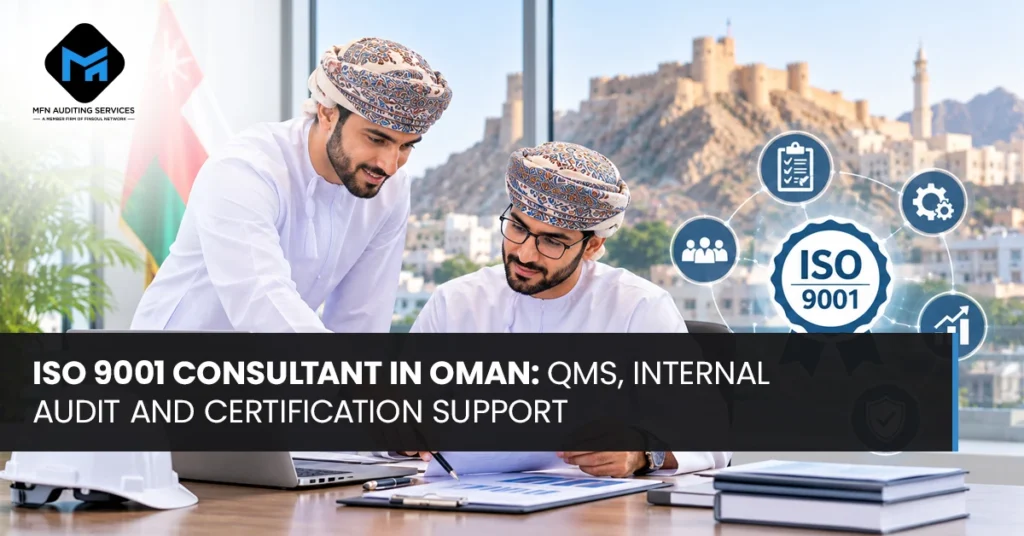
A quality management system needs to work in daily operations, not just look complete in an audit file. When customer complaints go unresolved, production errors keep recurring, delivery schedules slip or employees follow different procedures for the same task, the business lacks consistent quality controls. These problems affect customer satisfaction, operating costs and the company’s ability to compete for larger contracts.
Working with experienced ISO 9001 consultants in Oman gives your business practical support with QMS implementation, documentation, employee training, internal audits and certification preparation.
What Does ISO 9001 Certification Mean for Businesses in Oman?
ISO 9001 is an international standard for quality management systems. It applies to organisations of different sizes and industries, including construction, manufacturing, trading, healthcare, logistics, hospitality, engineering and professional services.
The standard focuses on how a business controls the activities that affect the quality of its products or services. This includes understanding customer requirements, assigning responsibilities, managing suppliers, monitoring performance, handling non-conformities and improving processes.
Certification confirms that an independent certification body has audited the organisation’s QMS and found it compliant with the applicable requirements. It gives customers, suppliers and business partners documented evidence of the company’s commitment to consistent quality.
For businesses in Oman, ISO 9001 certification can support:
- Tender and contract eligibility: Some government, semi-government and private-sector tenders specify ISO 9001 certification as a qualification requirement.
- Customer confidence: A recognised certificate provides independent evidence of a structured quality management system.
- Operational consistency: Documented processes help employees perform tasks according to approved procedures.
- Supplier management: Defined evaluation and monitoring procedures improve control over external providers.
- Business expansion: Certification can support supplier registration and commercial relationships with organisations that expect recognised quality standards.
ISO 9001:2026: The Current Quality Management Standard
Businesses preparing for certification in Oman need to work with the latest edition of the standard. ISO published ISO 9001:2026 on 16 September 2026, replacing ISO 9001:2015 as the current edition.
The revised standard retains the familiar management system structure while providing clearer requirements and additional emphasis on leadership, quality culture, accountability and the consideration of risks and opportunities. These updates reinforce the importance of making quality part of business decisions rather than treating it as a separate administrative responsibility.
Companies already certified to ISO 9001:2015 have a transition period to move to the 2026 edition. The published transition arrangements provide until 30 September 2029 for certified organisations to complete this change. Businesses need to coordinate their transition with their certification body and plan the necessary updates to their QMS.
Understanding the Main ISO 9001 Requirements in Oman
The ISO 9001 requirements Oman businesses need to address are based on the international standard, not a separate Omani version of the QMS. Organisations apply the requirements to their own activities, operating environment, customers and quality objectives.
The standard follows a ten-clause structure. The main requirements for implementation are covered in Clauses 4 to 10.
1. Context of the Organisation
The business needs to identify internal and external factors that affect its ability to deliver consistent products or services. This includes understanding customer expectations, regulatory obligations, supplier dependencies, market conditions and operational challenges.
For example, a construction company in Oman needs to consider project specifications, material suppliers, site conditions, client expectations and applicable contractual obligations when defining its QMS.
2. Leadership and Responsibility
Top management has an active role in establishing and maintaining the quality management system. Leaders need to define the quality policy, assign responsibilities, provide resources and make sure quality objectives support the organisation’s direction.
A QMS cannot operate effectively when responsibility for quality rests with one employee or department alone. Department managers and process owners need clear authority and accountability.
3. Planning
This requirement covers quality objectives, risks, opportunities and planned changes. Businesses need measurable objectives that relate to their actual operations.
A manufacturing company, for example, can monitor product defects, production delays and customer returns. A service provider can measure response times, complaint resolution and service delivery performance.
4. Support
The organisation needs appropriate people, infrastructure, equipment, knowledge and working conditions to operate its processes. Employee competence, awareness, communication and documented information also fall under this area.
Training records, equipment maintenance logs, approved procedures and controlled documents provide evidence that the business has established the necessary support arrangements.
5. Operation
Operational planning and control cover the activities involved in delivering products or services. This includes reviewing customer requirements, managing design and development where applicable, controlling external providers, production, service delivery and the release of outputs.
The controls need to reflect the organisation’s actual work. A trading company, for instance, will focus on purchasing, supplier evaluation, stock handling and order fulfilment, while a consultancy will place greater emphasis on client requirements, service delivery and review.
6. Performance Evaluation
A business needs to monitor and evaluate the effectiveness of its QMS. This includes analysing performance data, measuring customer satisfaction, conducting internal audits and holding management reviews.
Without regular evaluation, management cannot identify recurring problems or determine whether corrective actions are producing results.
7. Improvement
The organisation needs a process for dealing with non-conformities, taking corrective action and improving the effectiveness of its quality management system. Repeated mistakes need investigation rather than temporary correction.
QMS Implementation in Oman: From Assessment to Operational Control
Successful QMS implementation Oman businesses needs to start with their existing operations. Copying another company’s quality manual or preparing documents only for an audit does not establish an effective management system. The procedures need to match the organisation’s actual activities, responsibilities and risks.
MFN Auditing can support the implementation process through the following stages.
Initial Consultation and Scope Definition
The first step is to understand the organisation’s activities, locations, products or services, workforce and customer requirements. This information helps define the proposed certification scope.
The scope needs to describe the activities covered by the QMS accurately. A company operating from several locations also needs to establish which sites and processes fall within the certification boundary.
QMS Gap Analysis
A gap analysis compares existing business practices with ISO 9001 requirements. It identifies missing procedures, unclear responsibilities, weak controls and areas where the company needs additional records or monitoring arrangements.
The assessment also gives management a realistic view of the work involved. A business with established procedures and quality controls will have a different implementation workload from a company that has never maintained formal operating records.
Documentation and Procedure Development
Documentation provides employees with consistent instructions and gives auditors evidence of how the system operates. The exact documents depend on the company’s scope and processes.
QMS documentation includes:
- Quality policy and measurable quality objectives.
- Defined process responsibilities and authority.
- Procedures and work instructions where needed.
- Supplier evaluation and monitoring records.
- Customer requirement and complaint records.
- Training and competence records.
- Inspection, testing and monitoring records where relevant.
- Internal audit and management review records.
- Non-conformity and corrective action records.
Employee Awareness and Training
Employees need to understand the quality policy, relevant procedures and their responsibilities. Training also needs to address the competence required for specific roles.
For example, procurement staff need to understand supplier approval controls, while production employees need to follow the applicable inspection and process requirements. Internal auditors need suitable knowledge of the QMS and auditing methods.
Implementation and Monitoring
Once the procedures are approved, the organisation puts them into practice. Process owners maintain relevant records, monitor performance and report problems.
This stage is essential because an external auditor will look for evidence that the QMS operates in practice. A complete set of documents cannot compensate for procedures that employees do not follow.
ISO 9001 Internal Audit in Oman: Preparing Before Certification
An internal audit checks whether the quality management system meets ISO 9001 requirements and whether employees are following the organisation’s own procedures. It also identifies weaknesses before the external certification audit.
An effective ISO 9001 internal audit in Oman engages processes rather than relying on a document checklist. Auditors review records, interview employees, observe activities and compare actual practices with the QMS requirements.
What Does an Internal Audit Cover?
The audit scope depends on the organisation’s activities and certification boundaries. Common areas include:
- Document control and record management.
- Management responsibilities and quality objectives.
- Employee competence and training.
- Purchasing and supplier evaluation.
- Production or service delivery controls.
- Customer feedback and complaint handling.
- Inspection and performance monitoring.
- Corrective action and non-conformity management.
- Previous audit findings and improvement activities.
How to Handle Audit Findings
Internal audit findings need proper classification and follow-up. A non-conformity indicates that a requirement has not been met. The organisation needs to correct the immediate issue, investigate its cause and implement corrective action to prevent recurrence.
For example, if inspection records are missing for several completed orders, the company needs to investigate why employees did not maintain those records. Reissuing the forms alone will not address the underlying problem if the process, responsibility or training remains unclear.
The organisation also needs to retain audit records and verify that corrective actions have been effective.
Management Review and Continual Improvement
Management review gives senior leaders an opportunity to assess whether the QMS remains suitable, adequate and effective. It is more than a routine meeting or a signature on an audit document.
The review considers information such as:
- Progress against quality objectives.
- Customer satisfaction and feedback.
- Process performance and product or service conformity.
- Non-conformities and corrective actions.
- Internal and external audit results.
- Supplier performance.
- Changes affecting the organisation and its QMS.
- Risks, opportunities and resource requirements.
- Opportunities for improvement.
Management needs to record its decisions and actions. These can include changes to procedures, additional training, equipment investment, revised objectives or improvements to supplier controls.
A well-maintained management review process also gives the external auditor evidence that senior management takes responsibility for the effectiveness of the quality management system.
ISO 9001 Certification Process in Oman
After implementation and internal verification, the organisation can proceed to an independent certification audit. MFN Auditing provides consultancy and preparation support, while the certification decision remains with the independent certification body.
The process generally follows these stages:
- Select an appropriate certification body
The organisation identifies a certification body with relevant accreditation and experience in its industry and certification scope. The certificate’s acceptance by intended customers and tendering entities also needs consideration.
- Complete the application and audit planning
The certification body reviews the organisation’s details, scope, locations, workforce and relevant operational information. It then prepares the audit plan and confirms the arrangements.
- Stage 1 audit
The first stage reviews the organisation’s QMS documentation, scope, readiness and understanding of the requirements. The certification body identifies areas that need attention before the next stage.
- Stage 2 audit
The second stage evaluates how the QMS operates in practice. Auditors examine processes, interview employees, review records and check whether the system meets the standard’s requirements.
- Address non-conformities
If auditors identify non-conformities, the organisation needs to submit the required corrections and corrective action evidence within the certification body’s specified arrangements.
- Certification decision and issue
The certification body reviews the audit results and makes the certification decision. If the organisation meets the requirements, the body issues the ISO 9001 certificate.
ISO does not issue certificates or perform certification audits. These activities are handled by independent certification bodies. Businesses need to check the certification body’s accreditation and confirm that its scope covers the relevant QMS certification activities.
Common Problems During ISO 9001 Implementation
Businesses that treat ISO 9001 as a paperwork exercise frequently face problems during implementation and external audits. Addressing these issues early saves time and reduces disruption.
Preparing documents without changing actual practices: Procedures need to reflect the way employees perform their work. If the documented process and actual practice differ, auditors can identify the gap.
Unclear process ownership: Employees need to know who approves, performs and monitors each activity. Without defined responsibilities, tasks fall between departments, and records remain incomplete.
Weak internal audits: An audit that checks only whether forms exist will miss problems in operational controls. Auditors need to test how processes work and examine supporting evidence.
Poor corrective action: Repeating the same correction after every audit does not resolve the underlying cause. The organisation needs to investigate why the problem occurred and verify the effectiveness of its response.
Limited management involvement: Senior management needs to review performance, provide resources and make decisions based on QMS results. Delegating all responsibility to a quality officer leaves the system disconnected from business operations.
How MFN Auditing Supports ISO 9001 Certification in Oman
Preparing for certification takes more than downloading templates and arranging an external audit. Businesses need a QMS that reflects their activities, meets the applicable requirements and remains practical for employees to maintain.
MFN Auditing provides ISO consultancy services in Oman to help organisations prepare for ISO certification. Its support covers the assessment, documentation and preparation activities involved in establishing a management system.
The engagement can include:
- Reviewing existing processes and identifying QMS gaps.
- Defining the certification scope and implementation requirements.
- Preparing quality management documentation.
- Supporting employee awareness and training.
- Conducting internal audit preparation and system reviews.
- Helping management address non-conformities.
- Preparing the organisation for the independent certification audit.
- Supporting ongoing QMS maintenance and certification readiness.
The consultancy approach needs to reflect the organisation’s size, sector, existing controls and certification objectives. A small service company does not need the same documentation structure as a large manufacturer or construction contractor. MFN Auditing can help identify the work required and establish a practical route towards certification.
Frequently Asked Questions
Is ISO 9001 certification mandatory in Oman?
ISO 9001 certification is not a general legal requirement for every business in Oman. However, specific tenders, customer contracts and supplier qualification processes can make certification a condition of doing business.
What is the current version of ISO 9001?
ISO 9001:2026 is the current edition. It was published on 16 September 2026 and replaced ISO 9001:2015. Organisations already certified to the previous edition need to complete the transition within the published transition period.
How long does ISO 9001 certification take in Oman?
The timeline depends on the organisation’s size, number of locations, operational complexity and existing QMS arrangements. Businesses with established procedures and records generally have less implementation work than those starting from scratch. The certification body’s audit schedule also affects the overall timeline.
What documents are needed for ISO 9001 certification?
Common documents and records include the quality policy, quality objectives, process procedures, work instructions where required, supplier records, employee competence records, operational evidence, internal audit reports, management review records and corrective action documentation. The exact requirements depend on the organisation’s scope and processes.
Can a small business in Oman get ISO 9001 certified?
Yes. ISO 9001 applies to organisations of all sizes and sectors. A small business can implement a QMS that reflects its actual operations without creating unnecessary layers of documentation.
What is the difference between an ISO consultant and a certification body?
An ISO consultant helps the organisation understand the standard, implement its QMS, prepare documentation and conduct readiness reviews. A certification body independently audits the management system and makes the certification decision. The two roles are separate.
How frequently are ISO 9001 surveillance audits conducted?
Certification normally operates on a three-year cycle, with surveillance audits during the certification period and a recertification audit before the cycle ends. The certification body confirms the applicable audit schedule and arrangements.
Can MFN Auditing help with an existing ISO 9001 certificate?
Yes. Businesses with an existing certificate can seek support with QMS reviews, internal audits, corrective actions, ongoing maintenance and transition preparation for ISO 9001:2026.