
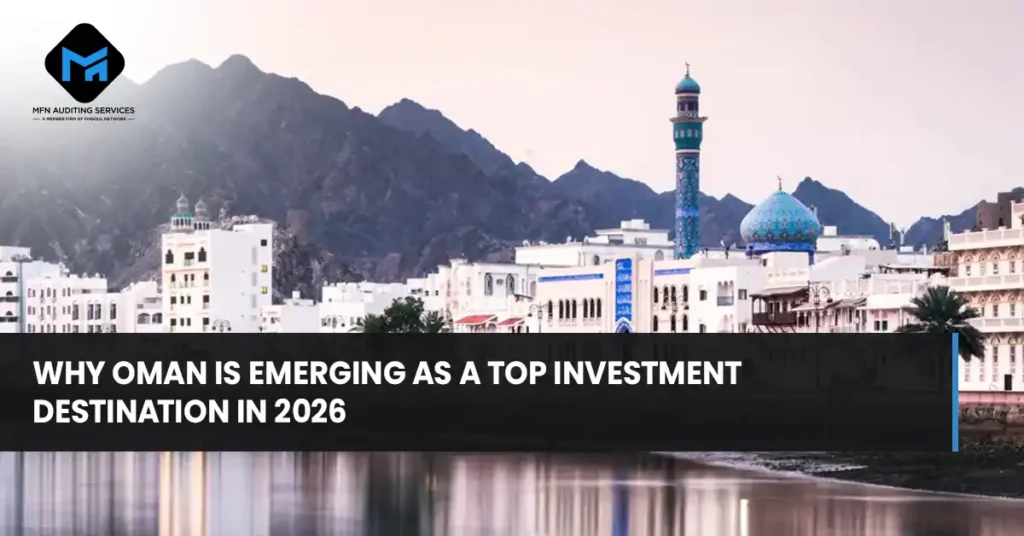
Global investor attention is shifting. While the UAE and Saudi Arabia have long dominated conversations about Gulf investment, Oman is quietly establishing itself as one of the region’s most compelling opportunities for businesses, entrepreneurs, and international capital looking for a stable, strategically positioned, and increasingly open market.
Over the past several years, Oman has undertaken a substantial transformation of its investment environment. Regulatory reforms, infrastructure expansion, free zone development, and a clear national vision for economic diversification have combined to create conditions that are attracting serious interest from investors who previously overlooked the Sultanate in favour of its larger neighbours. MFN Auditing examines why and what investors need to know before entering the market in 2026.
Why Oman Is Attracting Global Investors
Oman’s appeal as an investment destination is not built on a single advantage but on a combination of structural, geographic, and policy factors that distinguish it from other markets in the region. Each of the following elements contributes to a business environment that is increasingly difficult to ignore.
Strategic Location
Oman sits at the intersection of key global trade routes, with direct access to the Arabian Sea, the Gulf of Oman, and overland connections to Saudi Arabia and the UAE. Its position makes it a natural hub for businesses targeting GCC, South Asian, East African, and Indian Ocean markets simultaneously.
Political Stability
Oman has maintained consistent political stability across decades, providing the predictable operating environment that long-term investors require. The country’s neutrality in regional disputes and established governance structures reduce the political risk premium that affects investment decisions in other parts of the Middle East.
Strong Economic Reforms
Successive reform programmes have modernised the regulatory environment, reduced bureaucratic barriers, and opened previously restricted sectors to foreign participation. The pace of reform has accelerated under Vision 2040, signalling continued commitment to creating a competitive investment climate.
Investor-Friendly Policies
Recent legislative changes have expanded foreign ownership rights, simplified licensing procedures, and introduced incentives across priority sectors. The direction of policy consistently favours greater private sector participation and international investment.
Oman Vision 2040
The national development plan provides a clear framework for where the economy is headed, which sectors the government is prioritising, and where infrastructure investment will be concentrated. For investors, this roadmap reduces uncertainty and identifies the areas where government support and market growth are most likely to converge.
Oman Vision 2040 and Its Impact on Investment
Vision 2040 is not simply a policy document; it is actively shaping regulatory reform, infrastructure budgets, and sectoral incentives in ways that directly affect the investment landscape.
- Economic diversification: The plan explicitly targets reduced dependence on hydrocarbon revenues by developing manufacturing, tourism, logistics, and technology sectors as alternative growth engines
- Private sector growth: Vision 2040 sets targets for increasing private sector contribution to GDP, with accompanying reforms designed to facilitate business formation and expansion
- Digital transformation: Investment in digital infrastructure, e-government services, and technology adoption is a central pillar, creating opportunities for technology businesses and supporting operational efficiency across sectors
- Sustainability initiatives: Green energy, environmental management, and sustainable development commitments are shaping infrastructure investment and creating new business opportunities in renewable energy and green logistics
- Infrastructure development: Port expansions, industrial zone upgrades, road and rail connectivity projects, and airport development are all active priorities under the Vision framework
- Foreign investment reforms: Legislative changes enabling greater foreign ownership, expanded free zone incentives, and sector opening are direct outputs of the Vision 2040 investment agenda
Key Advantages of Investing in Oman
Beyond the structural factors attracting initial interest, Oman offers a set of practical business advantages that sustain and reward investment over the long term. These advantages are particularly relevant for businesses comparing Oman with other Gulf markets.
Strategic Gateway to GCC, Asia and Africa
Oman’s geographic position provides access to a combined market of billions of consumers across three continents, with established port infrastructure at Sohar, Salalah, and Muscat supporting logistics and distribution operations at scale.
Modern Infrastructure
Significant government investment in roads, ports, airports, industrial estates, and telecommunications has produced infrastructure that meets the requirements of modern manufacturing, logistics, and service businesses.
Competitive Business Costs
Office space, industrial land, labour costs, and utility rates in Oman are generally lower than in Dubai or Riyadh, improving the economics of operations for businesses sensitive to overhead.
Tax Advantages
Oman’s corporate tax rate and the absence of personal income tax create a favourable environment for business investment, particularly within free zones where additional incentives apply.
Skilled Workforce
A growing pool of Omani graduates, supported by government workforce development programmes, is increasing the availability of skilled local talent in sectors including engineering, technology, and financial services.
Business-Friendly Regulations
Streamlined company registration, digital licensing platforms, and clear regulatory frameworks reduce the friction involved in establishing and operating a business.
Stable Banking Sector
A well-regulated banking sector with strong international connections supports trade finance, project financing, and the corporate banking needs of both local and foreign investors.
High Quality of Life
Safety, affordable living costs, international schools, and a pleasant climate make Oman an attractive posting for expatriate employees and business owners, reducing the recruitment challenges that affect some regional markets.
Fastest-Growing Investment Sectors in Oman
Identifying the right sector is as important as identifying the right market. Oman’s fastest-growing areas reflect both the priorities of Vision 2040 and the country’s natural competitive advantages.
- Logistics: Oman’s strategic location and world-class ports at Sohar and Salalah position it as a regional logistics hub, supported by free zones and multimodal freight infrastructure.
- Manufacturing: Industrial estates offer competitive land, energy access, and export connectivity. Active sectors include food processing, building materials, chemicals, and electronics.
- Tourism & Hospitality: Natural heritage, cultural assets, and safety make Oman attractive for tourism, with opportunities in hospitality, adventure tourism, and ecotourism.
- Renewable Energy: Strong solar and wind resources drive large-scale projects in generation, storage, and green hydrogen, with government backing for private investment.
- Technology & Digital Services: Vision 2040’s digital agenda fuels demand for cloud services, cybersecurity, and software development, creating a supportive tech ecosystem.
Free Zones Driving Investment Growth
Oman’s free zones are among the most significant drivers of foreign investment attraction, offering conditions that distinguish the country from competitors across the Gulf. Each zone has distinct characteristics that make it more suitable for certain industries and business models.
Sohar Freezone
Located alongside one of the region’s fastest-growing ports, Sohar Freezone serves manufacturing, petrochemicals, metal processing, and logistics businesses. Its proximity to Sohar Industrial Port provides direct access to international shipping routes and raw material imports.
Salalah Free Zone
Situated in southern Oman near the Port of Salalah, one of the largest transshipment hubs in the Indian Ocean region, the Salalah Free Zone suits logistics, light manufacturing, and trading businesses targeting African, South Asian, and Middle Eastern markets.
Duqm Special Economic Zone
The SEZAD at Duqm is one of the largest economic zones in the Middle East by area. It hosts petroleum refining, petrochemicals, heavy manufacturing, maritime services, and tourism development, supported by a deep-water port and a new international airport.
Khazaen Economic City
Oman’s newest economic city, Khazaen is positioned to serve as a logistics and distribution hub for the broader Omani market, offering warehousing, light manufacturing, and commercial facilities with direct motorway access to Muscat and the northern region.
Foreign Investment Opportunities in Oman
Oman offers several distinct investment pathways, each suited to different business models, capital levels, and operational requirements. Understanding the options before committing to a structure prevents costly reorganisation later.
- Mainland companies: Businesses established on the Omani mainland operate under the Commercial Companies Law and benefit from access to the full domestic market, government tenders, and local commercial relationships
- Free zones: Offer enhanced foreign ownership rights, tax incentives, customs benefits, and infrastructure packages suited to manufacturing, logistics, and export-oriented businesses
- Industrial estates: Managed industrial areas offering serviced land and infrastructure for manufacturing businesses requiring proximity to utilities and transport connections
- Public-private partnerships: Infrastructure, utilities, and social services sectors offer structured PPP opportunities for larger investors with long-term project horizons
- Startup ecosystem: A growing network of incubators, accelerators, and government support programmes supports technology and innovation-driven businesses at early stages
How to Start Investing in Oman
Engaging local professional advisers at the outset reduces the risk of procedural errors and ensures that all regulatory requirements are met before operations begin.
Choose Your Business Activity
Define the commercial activity the business will conduct, as licensing, ownership structure, and regulatory requirements all depend on the specific activity being registered.
Select the Business Structure
Choose between mainland company structures, free zone entities, branch offices, and representative offices based on ownership requirements, operational needs, and market access objectives.
Register the Company
Submit the required documentation to the Ministry of Commerce, Industry, and Investment Promotion or the relevant free zone authority for registration and incorporation.
Obtain Licences
Secure all required commercial, sector-specific, and municipal licences before commencing operations. Licence requirements vary by activity and location.
Open a Corporate Bank Account
Establish a corporate bank account with a licensed Omani bank to manage business transactions, payroll, and regulatory payments.
Secure Visas
Arrange investor and employee visas through the relevant immigration authorities, ensuring compliance with Omanisation requirements applicable to the business activity.
Begin Operations
Once all registrations, licences, and visas are in place, the business can commence operations with the confidence that its regulatory foundation is properly established.
Challenges Investors Should Consider
None of the considerations below is unique to Oman, but all are relevant to planning a sustainable investment strategy.
- Regulatory compliance: Licensing requirements, Omanisation targets, and sector-specific regulations require ongoing attention and professional support to manage correctly
- Licensing timelines: Despite improvements, regulatory processes can take longer than in some regional peers, particularly for businesses in complex or regulated sectors
- Sector restrictions: Certain activities remain subject to ownership limitations or licensing conditions that restrict the entry options available to foreign investors
- Local market understanding: Consumer behaviour, commercial relationships, and business culture in Oman have distinct characteristics that require investment in local knowledge and partnerships
- Talent recruitment: While the workforce is developing, recruiting specialist skills in certain technical and professional areas remains competitive
- Market size: Oman’s domestic market is smaller than Saudi Arabia or the UAE, making export orientation an important consideration for businesses requiring scale
- Economic fluctuations: As a hydrocarbon-dependent economy in transition, Oman’s broader economic conditions remain partially linked to global energy markets
Why SMEs and Startups Are Choosing Oman
Oman is increasingly on the radar of smaller businesses and entrepreneurs who might previously have defaulted to Dubai as their Gulf entry point. The combination of lower costs, improving digital infrastructure, and government support programmes creates conditions that suit early-stage and growth-stage businesses particularly well.
- Lower operating costs: Office space, staffing, and overhead costs are materially lower than in Dubai or Doha, extending runway for early-stage businesses
- Growing digital economy: Government digitalisation programmes and improving internet infrastructure are creating a more supportive environment for digital businesses
- Startup-friendly ecosystem: Incubators, accelerators, and government innovation programmes are expanding the support available to new ventures
- Access to GCC markets: An Omani business provides a credible base for serving broader Gulf markets, particularly for businesses targeting logistics, manufacturing, or professional services
- Scalable business environment: The improving regulatory environment and expanding free zone infrastructure provide clear growth pathways for businesses that establish themselves successfully
Future Investment Trends in Oman
The investment landscape in Oman will continue to evolve as Vision 2040 initiatives mature, new sectors emerge, and global trends intersect with the country’s competitive advantages. Investors who position early in the areas below are likely to benefit from first-mover advantages as these markets develop.
- Green energy: Solar, wind, and green hydrogen projects are among the most significant investment opportunities emerging in Oman over the next decade
- Artificial intelligence: Government digitalisation initiatives and private sector technology adoption are creating growing demand for AI solutions across industries
- Smart logistics: Automation, data analytics, and connected supply chain technologies are being integrated into Oman’s port and logistics infrastructure
- FinTech: A growing regulatory framework for financial technology is creating space for payment, lending, and financial services innovation
- Advanced manufacturing: Higher-value manufacturing in pharmaceuticals, aerospace components, and precision engineering is a target for industrial development
- Tourism expansion: Eco-tourism, cultural tourism, and adventure tourism investment is expected to increase significantly as visitor infrastructure improves
- Sustainable infrastructure: Green building, water management, and waste processing investment opportunities are expanding alongside environmental regulatory development
Invest in Oman with Confidence
Oman’s transformation under Vision 2040 is creating one of the Gulf’s most compelling investment landscapes. From logistics and manufacturing to renewable energy and technology, opportunities are expanding across every sector. With MFN Auditing Oman, your business gains expert guidance to manage regulatory frameworks, identify the right investment pathways, and establish a strong local presence.
Email: info@mfnauditing.com
Phone: +968 7733 8545
Conclusion
Oman is strengthening its position as one of the Gulf’s most credible investment destinations through a sustained combination of economic diversification, investor-friendly reform, strategic infrastructure investment, and a clear national development vision. The country offers advantages that are distinct from, and in some cases superior to, those of its larger regional neighbours for businesses in the right sectors with the right investment profile.
Every investment decision should be grounded in thorough market research, proper legal and professional advice, and a realistic understanding of both the opportunities and the challenges the market presents. Businesses that align their strategies with Oman’s growth sectors, comply with its regulatory framework, and commit to building a genuine local presence are well placed to benefit from the considerable opportunities emerging in 2026 and beyond.
Frequently Asked Questions
Why is Oman becoming an attractive investment destination?
A combination of strategic geography, political stability, economic reform, free zone development, and Vision 2040’s diversification agenda is making Oman increasingly competitive with other Gulf investment destinations.
Can foreigners own 100% of a company in Oman?
In free zones, 100% foreign ownership is widely available. On the mainland, recent legislative reforms have expanded the sectors where full foreign ownership is permitted, though some activities still require Omani participation.
Which industries offer the best investment opportunities?
Logistics, manufacturing, renewable energy, tourism, technology, and healthcare are among the sectors offering the strongest growth prospects and government support in 2026.
What are the main tax benefits of investing in Oman?
No personal income tax, a moderate corporate tax rate, and additional exemptions within free zones create a broadly favourable tax environment for investors.
Is Oman a good place for startups?
Yes, particularly for businesses that benefit from lower operating costs, access to GCC markets, and a less saturated competitive environment than Dubai or Riyadh.